
by Eurolng.com Staff
Small-scale LNG market in Portugal
Structure, main suppliers and 2025 volumes
Portugal’s small-scale LNG (ssLNG) market is relatively compact and centred on a single major hub — the Sines LNG terminal. Unlike Germany or Italy with hundreds of refuelling stations, Portugal is dominated by a “terminal → road tanker → satellite regasification units and bunkering” model. Below is how the market is structured, who the key players are and what volumes were recorded in 2025.
1. Market structure
The central element is the Sines LNG terminal (operator REN Atlântico). In 2025 it received 46 LNG carriers and unloaded about 47.7 TWh of LNG, covering roughly 94–97% of all gas entering the national system. In parallel the terminal loads road tankers: up to 36 trucks per day.
This road branch forms the ssLNG segment: gas is delivered to autonomous gas units (UAG) on the mainland, to Madeira (virtual pipeline via the port of Lisbon) and increasingly to ship bunkering. The country has dozens of satellite regasification plants (around 50+ for distribution plus further private units).
2. Small-scale LNG volumes in 2025
According to REN and the regulator ERSE, in 2025 some 2.2 TWh of LNG was dispatched by road from the Sines terminal — a record annual volume, up about 2.5–2.9% on 2024. The number of tanker trips was around 7,546.
For comparison: total natural gas consumption in Portugal in 2025 was about 45 TWh (+11% year-on-year). Road ssLNG is therefore a small but steadily growing and strategically important niche (off-grid industry, islands, bunkering).
3. Main suppliers and players
Molgas
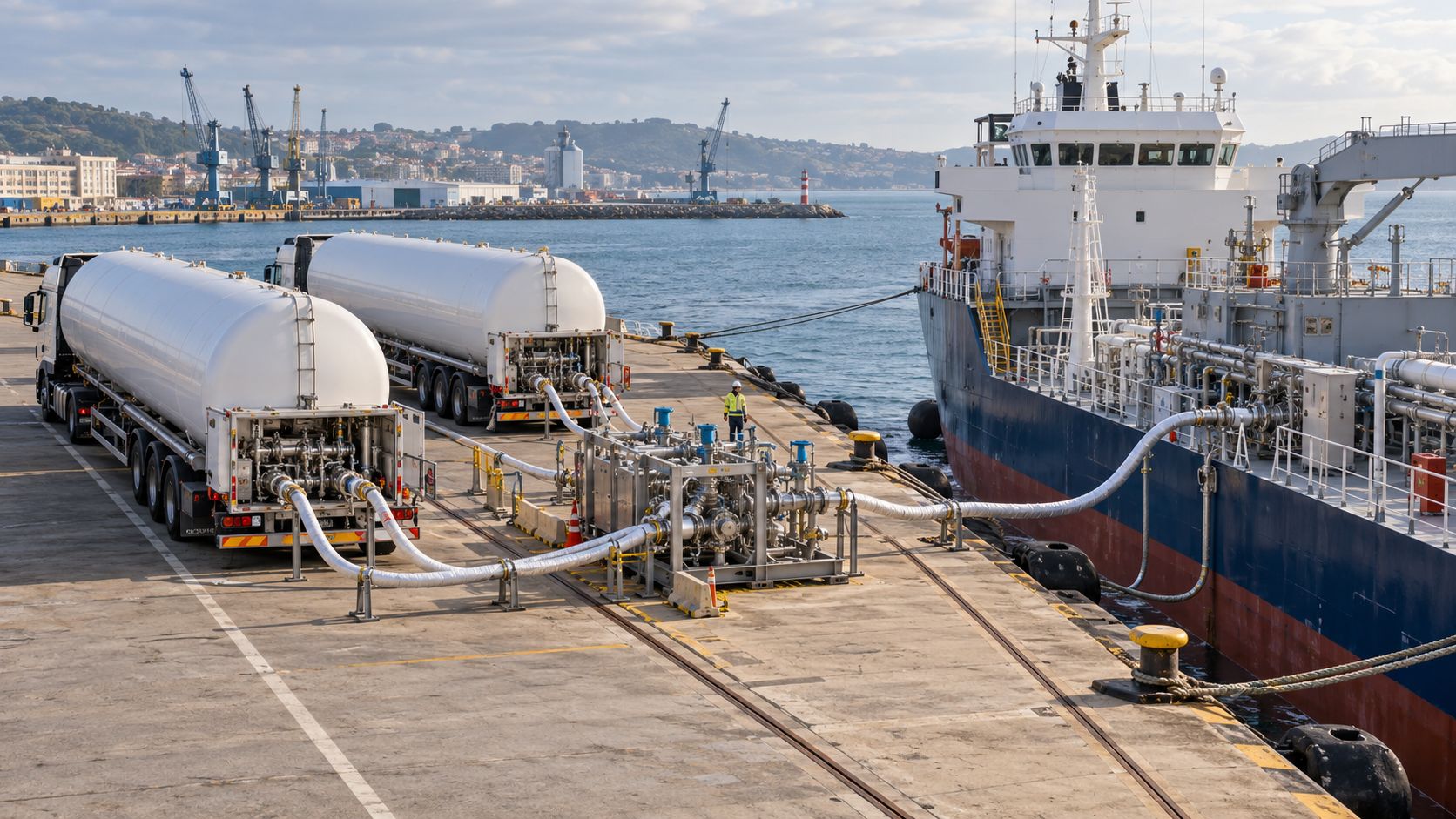
One of the most active players in the ssLNG and bunkering segment. In September 2025 Molgas carried out the first LNG bunkering operation at the Port of Leixões (Porto) using the multi-truck-to-ship method, establishing a permanent supply point. The company has stated plans to expand supply to other Portuguese ports. Commercial Director of Molgas Portugal is Fernando Breda.
Galp
Portugal’s largest energy company. Holds long-term LNG contracts (including with Venture Global) and participates in the Madeira supply chain (historically via the Gaslink consortium with Grupo Sousa). An important player on the large-import side and in parts of the off-grid chain.
REN Atlântico
Operator of the Sines terminal: reception, storage, regasification and truck loading. Without this infrastructure the Portuguese ssLNG market would effectively not exist.
In addition: industrial consumers and operators of satellite re-gas stations, plus the growing marine bunkering segment linked to the wider Iberian market (Spain + Portugal), where LNG bunkering volumes rose sharply in 2025.
Key figures 2025
| Indicator | 2025 value |
|---|---|
| LNG truck loading (Sines) | 2.2 TWh (~7,546 trips) |
| Sines terminal receipts | ~47.7 TWh (46 vessels) |
| Total gas consumption | ~45 TWh (+11% y/y) |
| Sines share of gas entry | ~94–97% |
4. Trends and outlook
The Portuguese ssLNG market remains niche compared with Central and Northern Europe, but has clear growth drivers: bunkering (first permanent point at Leixões, plans for other ports), island supply and off-grid industry, as well as the broader Iberian LNG bunkering boom. Bio-LNG is not yet as dominant as in Germany, but interest in low-carbon molecules is rising with shipping and industry requirements.
Conclusion
Small-scale LNG in Portugal is primarily logistics from the Sines terminal by road tanker (2.2 TWh in 2025) plus emerging bunkering. The key active supplier in bunkering and flexible deliveries is Molgas; on the large-import and part of the chain side is Galp; infrastructure is provided by REN. The market is small but infrastructure-backed and has growth potential from the marine segment and off-grid demand.