
by Eurolng.com Staff
Why the small-scale LNG market matters
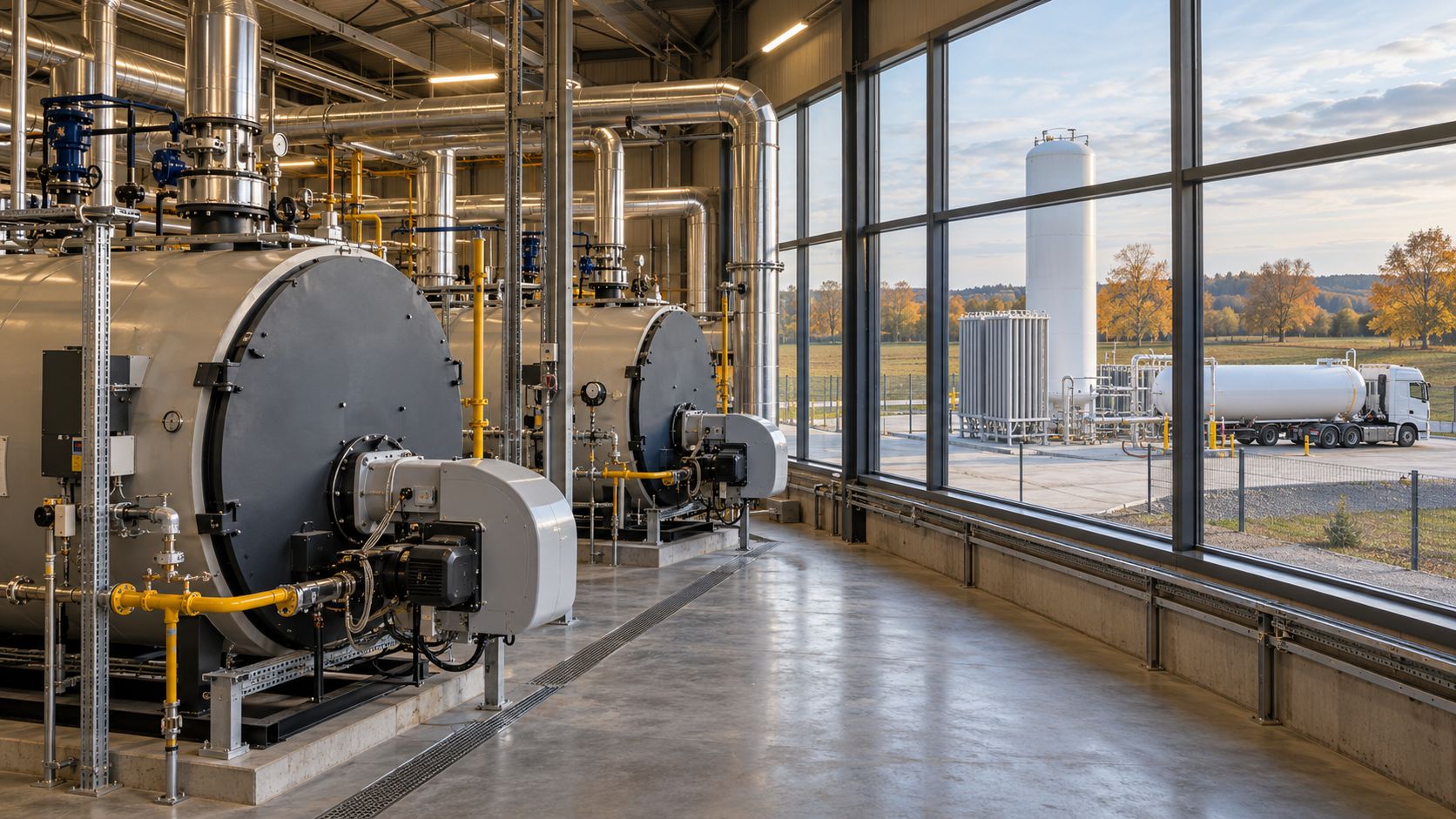
Segment specifics, the shift to Bio-LNG, how it emerged in Europe, and a 10-year outlook
Small-scale LNG (ssLNG) is not a “miniature copy” of the large-scale market. It is a separate segment with its own logistics, customers and rules of the game. It links large terminals with end users that pipelines do not reach: road transport, industry outside the gas grid, ship bunkering and local regasification stations. In recent years this market has relied more and more on Bio-LNG, or liquefied biomethane.
1. Why the ssLNG market matters
Supply flexibility. Road tankers and small vessels deliver gas where there is no trunk pipeline. A single truck-and-trailer unit typically carries about 18 tonnes of LNG (roughly 270–275 MWh), which is enough for industrial customers, filling stations and local regasification stations.
Energy security. After the cuts in Russian pipeline gas, ssLNG became a diversification tool for the Baltics, Central Europe and Southern Europe. Terminals in Klaipėda, Świnoujście, Gate, Sines and other hubs have become loading points for “virtual pipelines”.
Decarbonisation of transport and industry. LNG already cuts CO₂ emissions and almost eliminates SOx and particulate matter compared with diesel and fuel oil. Bio-LNG goes further, to a near-zero or even negative carbon footprint when made from manure and waste.
Link to the large-scale market. ssLNG relies on the same terminals and TTF quotations but adds a logistics premium and service. Growth in large-scale LNG imports into the EU directly widens the base for the small-scale segment.
2. Specifics of the small-scale segment
Supply volumes are tens and hundreds of tonnes, not millions. The chain is shorter: terminal → road tanker / bunker vessel → customer. Contracts are more often short-term or spot, and the price is usually linked to TTF plus logistics and margin. Customers are vehicle fleets, industrial plants, ports and local energy companies. The market is fragmented, with different leaders in each country
Physical accessibility is critical: delivery distance is usually up to 600–700 km from the loading point, and the average transport rate is about €1.9/km. Quality and certification (including PoS for Bio-LNG) are becoming as important a selection factor as price.
3. Customers switching to Bio-LNG
More and more ssLNG customers are moving from fossil LNG to Bio-LNG. The reasons are the requirements of FuelEU Maritime and the ETS, corporate Scope 1/3 targets, premiums for a low carbon footprint, and the ability to use the same infrastructure (the same tankers, filling stations and bunker vessels). Bio-LNG is a drop-in fuel: no engine or tank replacement is needed.
In Northern Europe the share of the bio component in bunkering and road transport is already noticeable. In Sweden, Norway, the Netherlands and Germany, contracts for Bio-LNG supply to ferries, trucks and port equipment are growing. For traders this is an opportunity to sell not just the “molecule” but also a certificate of origin and the emission reduction.
4. How Bio-LNG emerged in Europe
The first commercial steps date from the late 2010s and early 2020s.
- Italy (2018): one of the first industrial biomethane liquefaction plants.
- Netherlands (October 2021): launch of the first Dutch Bio-LNG plant in Amsterdam (Nordsol / Renewi / Shell), producing biomethane from organic waste.
- Germany (2022–2024): the first local plants (Darchau and others), followed by large projects (including integration at EnviTec sites and those of other operators).
- Sweden and Scandinavia: biomethane liquefaction developed on the basis of existing biogas plants (Gasum, St1 Biokraft, Tekniska Verken and others); by 2025 Sweden was producing hundreds of GWh of liquid biomethane a year.
- Gate (Rotterdam, 2024): Bio-LNG production started on the terminal’s existing liquefier, an important step toward scaling through large hubs.
5. Which fuels it competes with today
The main competitor of ssLNG and Bio-LNG in road transport is diesel. In industry and local energy it is fuel oil, LPG and coal, where they are still in use. In bunkering it is marine fuels (VLSFO, MGO) and a growing range of biofuels.
On the price of the “molecule”, LNG often beats diesel at a moderate TTF. Bio-LNG is more expensive, but quotas, FuelEU and corporate commitments offset the difference. LPG remains a strong competitor in some Central and Eastern European countries thanks to its developed infrastructure. Electrification of heavy transport and hydrogen are still limited by range, infrastructure and cost, so over a 5–10 year horizon ssLNG and Bio-LNG keep their niche.
6. Ten-year outlook (to about 2035–2036)
The ssLNG segment in Europe will keep growing, but the structure of demand will change.
- Volumes and infrastructure. According to industry estimates, the small-scale LNG market in Europe will keep growing at roughly 5–8% a year in value terms until the end of the decade. The drivers are road transport, industry and, above all, bunkering.
- Bio-LNG becomes the main “green” layer. In analysts’ scenarios the global Bio-LNG market could grow several-fold (double-digit CAGR) by 2035. Europe will remain the leader in share and policy (RED, FuelEU, ETS). The share of the bio component in ssLNG supplies for transport and bunkering will be markedly higher than today.
- Competition. Diesel and fuel oil will gradually be displaced in regulated segments. Pressure will come from e-methane, hydrogen and batteries on short routes, but for long-haul trucks, ferries and off-grid industry, Bio-LNG and LNG will retain the advantages of energy density and compatibility with existing equipment.
- For traders and suppliers. The keys will be access to certified biomethane, logistics from the Baltics and north-western hubs, flexible price formulas (TTF + premium + PoS) and long-term contracts with fleets and industry.
Conclusion
The small-scale LNG market matters as a bridge between large terminals and end users outside the gas grid. Its defining features are flexible logistics, a link to TTF and the growing role of certified Bio-LNG. Bio-LNG appeared in Europe at the turn of the 2010s and 2020s and has already entered bunkering and road transport. Today it competes mainly with diesel, LPG and marine fuels. Over a 10-year horizon the segment will keep growing, and Bio-LNG will take a larger share of “green” supply, while fossil LNG remains a transition and balancing fuel.