
by Eurolng.com Staff
Bio-LNG in Sweden: plants, bunkering and development plans
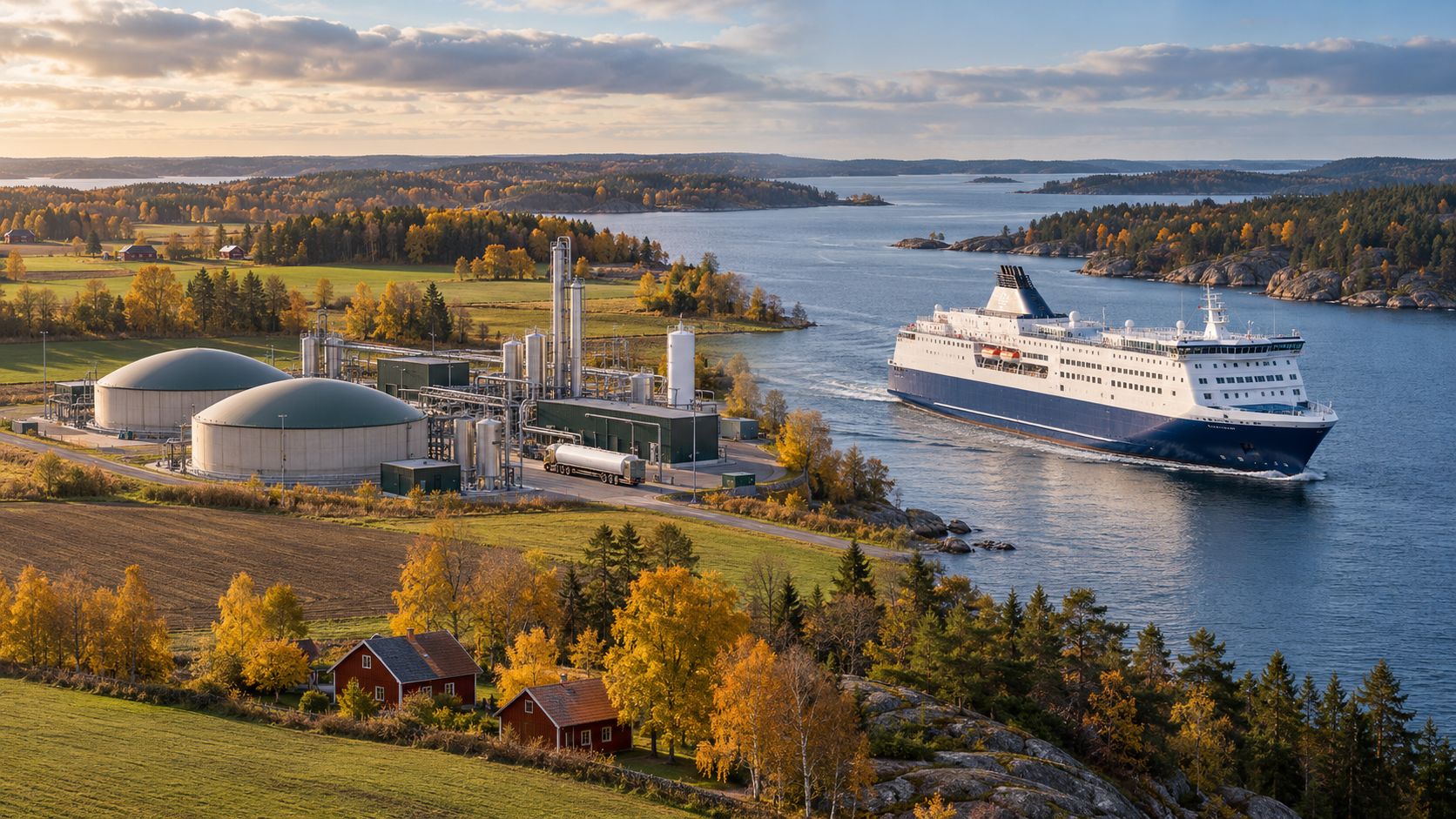
St1 Biokraft Mönsterås, 2025 volumes and outlook to 2030
Swedish company St1 Biokraft has completed the first bio-LNG delivery from its new plant in Mönsterås. This is one of the country’s flagship projects and a reason to review the entire liquefied biomethane (LBG / Bio-LNG) segment in Sweden: operating plants, volumes, bunkering and expansion plans.
1. St1 Biokraft Mönsterås — the flagship plant
The plant in Mönsterås (Kalmar County) was inaugurated in September 2025. It is St1 Biokraft’s 13th facility. Annual capacity is about 138 GWh of bio-LNG (equivalent to roughly 13 million litres of diesel). Feedstock is around 260,000 tonnes of manure per year from one of Sweden’s most livestock-dense municipalities. The first delivery took place in August 2025; full capacity was targeted for the end of 2025 / early 2026.
In 2026 St1 Biokraft made its first delivery of Swedish-produced bio-LNG to Baltic shipping (Destination Gotland, part of the volume on the Visby–Nynäshamn route). In October 2026 a contract was signed with Finnish Wasaline for 42 GWh of bio-LNG per year from January 2028 for the Aurora Botnia ferry (Vaasa–Umeå).
2. Bio-LNG production in Sweden in 2025
According to Energigas Sverige, in 2025 eleven plants produced 331 GWh of liquid biomethane — up 31% on 2024. Net imports of liquid biomethane reached 571 GWh (+14%), and total consumption 902 GWh (+20%). Overall Swedish production of biogas and biomethane rose 12% to 2,688 GWh.
Much of the new and planned capacity is oriented toward liquefaction: in the absence of a gas grid across large parts of the country, LBG is easier to move by road tanker to end users (transport, industry, ports).
3. Key plants and projects
| Plant / project | Capacity | Status / note |
|---|---|---|
| St1 Biokraft Mönsterås | ~138 GWh/year | In operation since 2025; manure |
| Gasum Götene | 120 GWh/year | Since 2025; ~400 kt manure |
| Tekniska Verken Linköping | ~200 GWh/year | Expansion 2025; CCU |
| Nordion Energi Gothenburg | ~50 t/day | Under construction; start 2027 |
| Biogas Västra Skaraborg (Vara) | up to 70 GWh/year | Under construction; 113 farmers |
Other sites (Södertörn, further Gasum and St1 Biokraft assets) complete the map. St1 Biokraft targets 3 TWh of own biogas production by 2030; Gasum aims for 7 TWh of renewable gas by 2027 (group-wide).
4. Bunkering and demand for bio-LNG
Sweden is increasingly using bio-LNG in shipping. The Port of Gothenburg is one of Northern Europe’s hubs for alternative bunkering. Swedish biomethane has already been supplied to vessels (including Terntank), Destination Gotland deliveries have taken place, and longer-term contracts exist (Wasaline). FuelEU Maritime and cargo-owner requirements are reinforcing demand for certified biomethane.
On land, bio-LNG goes into heavy road transport and industry. The LBG/LNG filling-station network in the country comprises around thirty sites (Gasum, Circle K, Svensk Biogas and others).
5. Plans to 2030
Energigas Sverige estimates that large-scale plants under construction or planned could add about 2.9 TWh of biomethane by 2030 — nearly a doubling of current Swedish production. A substantial share of the new capacity is liquefied biomethane. Centralised liquefaction units at ports and existing biogas plants (at least 0.4 TWh of LBG per year) are also being developed.
Feedstock is shifting toward manure and agricultural residues: this offers a high potential for emission reduction (down to a negative carbon footprint) and supports rural areas.
Conclusion
Sweden is rapidly expanding bio-LNG production. St1 Biokraft’s Mönsterås plant (~138 GWh) is one of the largest in the country and is already linked to marine supply. In 2025 national production of liquid biomethane reached 331 GWh (+31%), and total consumption 902 GWh. New projects (Götene, Linköping, Gothenburg, Vara and the wider St1 Biokraft portfolio) and players’ targets to 2027–2030 make Sweden one of the key Bio-LNG suppliers for transport and bunkering in Northern Europe and the Baltic.