
by Eurolng.com Staff
Bio-LNG for ships: enough gas, not enough of the right molecules
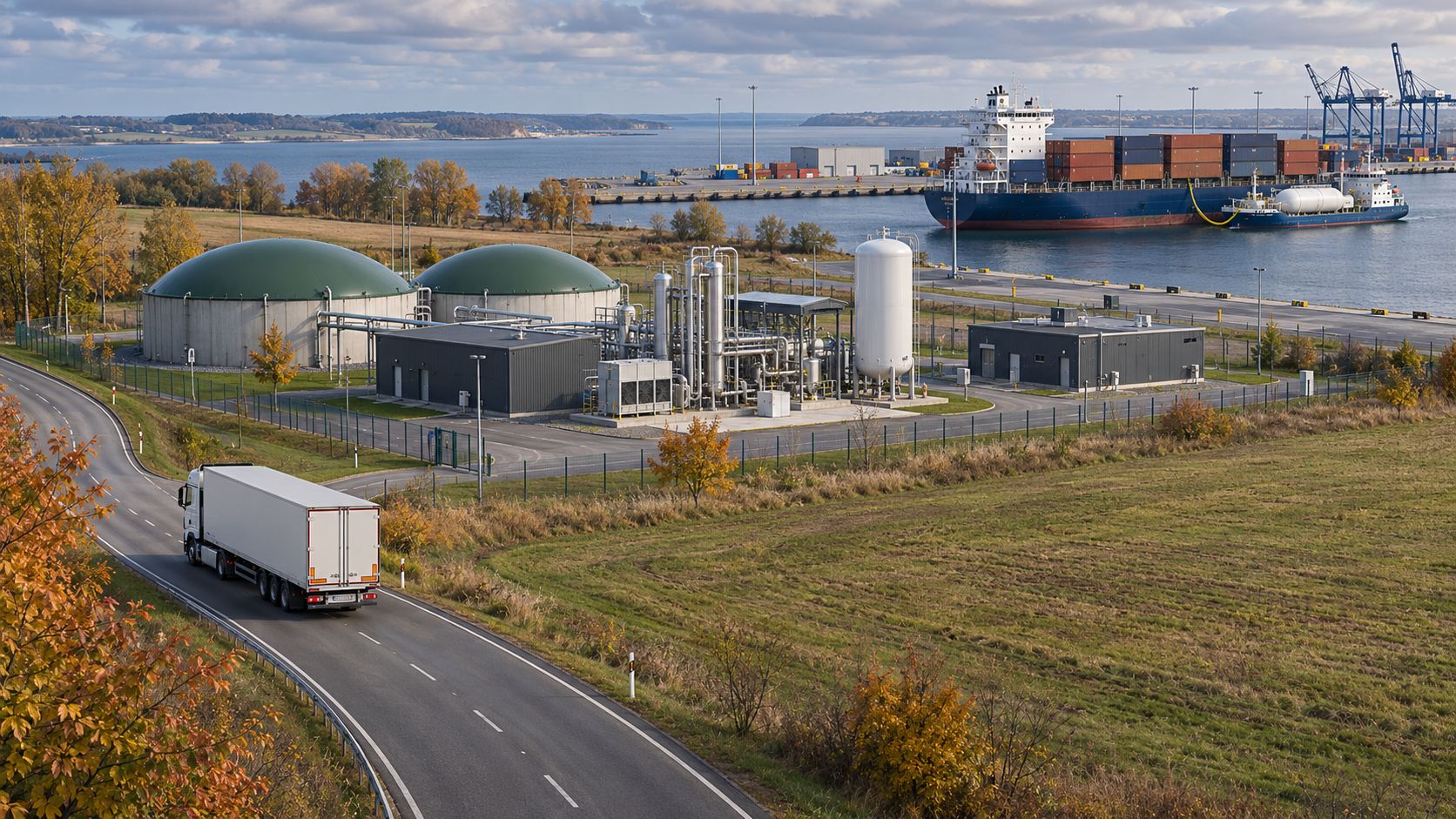
FuelEU has made certified bio-LNG a compliance fuel. Europe is not short of biomethane in total. It is already short of the low-carbon certificates shipping is bidding for — and production will not match a demand curve that keeps compounding.
1. Two balances, not one
European biomethane production was 5.2 bcm in 2024, of which 4.3 bcm in the EU-27. Combined biogas and biomethane output was 22 bcm. Installed biomethane capacity reached 8.2 bcm/year by the end of the second quarter of 2026. Rotterdam’s entire 2025 bio-LNG bunker book was 17,644 m³. On a cubic-metre basis, ships are not about to empty Europe’s plants.
Shipping does not buy average biomethane. It buys certified liquefied biomethane, preferably from waste or manure, because FuelEU pooling pays for over-compliance and the lowest carbon intensity clears first. That book is already tight. Most Dutch and Danish supply for 2026 had been sold into maritime, and suppliers still described high liquefied-biomethane prices through the first half of 2026.
A further sixfold year in bunkered bio-LNG will not repeat. That rate is a base effect. Absolute tonnes, and the certificates behind them, can keep rising steeply. Production of all biomethane can absorb the first. It will not absorb the second.
2. What the rules are buying
FuelEU Maritime has applied since 1 January 2025 to cargo and passenger ships above 5,000 GT. Greenhouse-gas intensity is measured well-to-wake against a 2020 baseline of 91.16 gCO2e/MJ, and it includes methane and nitrous oxide. The 2% step holds through 2029.
| From | Cut vs 2020 | Limit, gCO2e/MJ |
|---|---|---|
| 2025 | 2% | 89.3 |
| 2030 | 6% | 85.7 |
| 2035 | 14.5% | 77.9 |
| 2040 | 31% | 62.9 |
| 2045 | 62% | 34.6 |
| 2050 | 80% | 18.2 |
The first step is mild. Fossil LNG, especially on high-pressure two-stroke engines, can sit inside it and still generate a surplus. Bio-LNG’s first commercial job has therefore not been “every ship blends 10%”. It has been a smaller set of LNG-capable ships over-complying, then selling the surplus into a pool.
From 2026, EU ETS coverage of maritime emissions moves to 100%, and methane and nitrous oxide enter the accounting. FuelEU remains the larger price signal for bio-LNG. A proposed Sustainable Maritime Alternative Propulsion mechanism — up to 110 million allowances between 2028 and 2040 — would widen the gap further. It is not law.
Titan’s case of an 8,000 TEU ship on a North Europe loop, burning about 18,000 tonnes of LNG-equivalent a year, all inside FuelEU scope, shows the timing. Fossil LNG keeps that ship compliant through 2035. From 2040 a blend of about 15% liquefied biomethane restores compliance. A 30% blend throws off more than 34,000 tonnes of CO2-equivalent surplus a year, worth roughly €3.4–5.1 million in gross pooling value on Titan’s figures. Owners buy bio-LNG before the rule forces them to.
3. Demand: small tonnes, fast certificates
| Indicator | 2024 | 2025 | Early 2026 |
|---|---|---|---|
| Rotterdam bio-LNG bunkers | 2,775 m³ | 17,644 m³ | 15,260 m³ in Q1, almost all of 2025 |
| Rotterdam LNG bunkers | — | above 1 million m³ | — |
| Zeebrugge bio-LNG demand | — | over 2.5 TWh, +73% | — |
| of which ship bunkering | 175 GWh | 950 GWh | — |
| Enagás bio-LNG loadings | — | 705 GWh, 96% for bunkers | — |
| Titan: LBM share of methane delivered | 6.5% | 19.1% | prices still high in H1 |
| Gasum: bio-LNG share of maritime gas | 0.8% | 12.3% | — |
These series must not be added. Rotterdam is physical bunkering. Zeebrugge’s 2.5 TWh is terminal demand, mostly mass-balance liquefaction for trucks and small ships: almost 70% of truck loadings and almost 40% of small shiploads. Enagás is loadings at Spanish terminals. Supplier shares are company books, not a European average. Bio-LNG was still under 2% of Rotterdam’s LNG bunkers in 2025.
The demand that sets the price over the next two years is the certificate bid. Mass balance lets biomethane injected in one country be claimed as bio-LNG withdrawn at a terminal. That is how a 5 bcm system serves a bunker market still counted in tens of thousands of cubic metres — and how a few pools can take a whole country’s merchant supply for a year.
Further out, the figures are scenarios, not bookings.
- Under FuelEU alone, DNV puts compliance-driven demand for low-GHG methane at 2–4 million tonnes by 2040 — on the order of today’s entire European biomethane output, and a 2040 number, not a 2027 one. The same paper has global biomethane at about 7 million tonnes in 2024 and about 15 million tonnes by 2030. Operating e-methane is 0.01 million tonnes, with 0.9 million tonnes announced for 2030. It is not a backstop this decade.
- Wood Mackenzie has argued that shipping could become the single largest pull on European biomethane, and by 2050 could take more than half of projected European production capacity. Dedicated bio-LNG liquefaction, as distinct from the grid-and-certificate route, was only about 0.15 bcm in 2024.
- The sink is an LNG-capable fleet of about 900 ships, excluding LNG carriers, with roughly 650 more due before 2030. Fossil LNG can carry much of that fleet through the 2% step and into the 6% step. The blend ratio, not the ship count, is what turns the fleet into a biomethane buyer.
Percentage growth will slow. Tonne growth is what competes with other buyers. Rotterdam’s first quarter of 2026 already nearly matched the whole of 2025.
4. Supply is adding about 1 bcm a year
| Figure | What it is | |
|---|---|---|
| Biomethane production, 2024 | 5.2 bcm (4.3 in the EU-27) | output, not capacity |
| Biogas + biomethane, 2024 | 22 bcm Europe / 19 bcm EU-27 | mostly still biogas |
| Installed biomethane capacity | 7 bcm in early 2025; 8.2 bcm at end-Q2 2026 | nameplate |
| Plants | 1,620 at end-2024; 1,975 on the 2026 map | 327 commissioned between counts; some closures |
| Geography | five countries, about 95% of output | success in a short list, not a European system |
| Identified investment | €28.4 billion; about 7.3 bcm of extra capacity by 2030, up to 9 bcm if later projects land | a pipeline |
| REPowerEU | 35 bcm by 2030 | non-binding |
| National plans vs that target | a gap of about 20–23 bcm | not a delivery schedule |
| Technical potential, EU-27 | 31–32 bcm by 2030; 163–184 bcm by 2050 | feedstock potential, not a forecast |
In 2024, output sat several bcm below nameplate. A plant that injects does not automatically hold a maritime certificate, a waste feedstock, or a place in a liquefaction chain. At about 1 bcm of new capacity a year, 35 bcm is not a supply forecast. Even if the investment pipeline arrives in full, Europe in 2030 is closer to the mid-teens than to the political target — and those molecules already have buyers in road fuel, national RED III quotas, industry and heat.
Zeebrugge already shows the split. Bio-LNG there is a heavy-truck fuel as much as a bunker fuel. New quota schemes landing in 2026 will bid against ships for the same gas.
Feedstock quality narrows the maritime book again. The volumes that clear a pool at a useful price are the ones with the deepest greenhouse-gas cut. Those streams are growing. They are not the 5.2 bcm.
5. Will it be enough?
Through 2029, yes on volume, no on the certificate the owner wants. The 2% step does not require a large blend. Physical bunkering can keep growing off a small base without exhausting European production. The constraint is already commercial. Subsidised low-carbon product is pre-sold, the spread between subsidised and unsubsidised bio-LNG has narrowed because buyers chased the subsidised barrel, and prices stayed high into 2026. A charterer who treats bio-LNG as a spot top-up will pay the pooling premium. One who contracts waste-based volumes multi-year will get the fuel.
From 2030 to 2035, only if production leaves the current slope and shipping does not take the whole compliance job. The limit moves from 2% to 6%, then toward 14.5% in 2035. Fossil LNG’s free ride shortens, first on low-pressure engines. A 10–20% blend on a fleet several hundred ships larger than today’s is a call measured in bcm, not in Rotterdam’s 18,000 m³. That is coverable if European biomethane is in the mid-teens and only a slice is maritime. It is not coverable if output is still near today’s level and road-fuel quotas grow beside it.
After 2035, no — not if demand keeps the logic of the last two years. A 15% blend to stay inside the 2040 limit, on a larger LNG fleet, plus pooling demand from oil-fuelled ships, is a structural claim on European biomethane. Waste feedstock will not scale with that claim. E-methane might, but not on volumes announced for 2030. Imports of certified biomethane stretch the book. They do not remove the competition.
6. Three switches that matter more than the next bunker print
Liquefaction by equivalence. Most bio-LNG never sees a dedicated liquefier. Biomethane is injected, a certificate moves, and a terminal issues bio-LNG against its own liquefaction. Dedicated capacity was about 0.15 bcm in 2024. Through the summer of 2026 the Commission was still revising the certification rules that govern this pathway. Industry groups warned that loading fossil LNG-chain emissions onto mass-balance bio-LNG would make the route unviable and cut renewable fuel for ships without adding a plant. If that draft lands as written, the squeeze arrives before the production gap does. If equivalence is confirmed, the 8 bcm system can keep serving ships.
Who wins the feedstock. Maritime can outbid heating. It cannot outbid every RED III ticket scheme and the truck-fuel obligation at once, not for manure-based gas. The next shortage will show up as a wider premium for negative-intensity product, not as empty tanks at every LNG berth.
How long fossil LNG stays “compliant enough”. If methane slip and the well-to-tank default keep fossil LNG inside the limit until the mid-2030s, bio-LNG stays a pooling product: high price, limited tonnes. If those factors pull the blend forward, demand jumps a generation earlier than the 2040 case. That number is regulatory, and it is not settled.
Takeaway
The sixfold rise in Rotterdam does not mean Europe must already produce 35 bcm for ships. The bunkered book is still small next to 5.2 bcm of output. Those 5.2 bcm do not mean supply is comfortable. The molecules with a FuelEU value are a subset, several national books for 2026 are already placed, and a build rate of about 1 bcm of capacity a year will not match certificate demand that keeps compounding.
For small-scale players the split is practical. Physical logistics can scale: terminals, trucks, bunker vessels. The renewable attribute cannot, not at the 2025 pace, and not from European plants alone. Over the next three years, availability is a contracting problem. From 2030 it becomes a production problem. Past 2035, bio-LNG remains a compliance tool for the LNG fleet only if blends stay modest, waste supply grows, and e-methane or imports cover the tonnes European biomethane will not have.