
by Eurolng.com Staff
Stade onshore terminal: what it changes for small-scale LNG
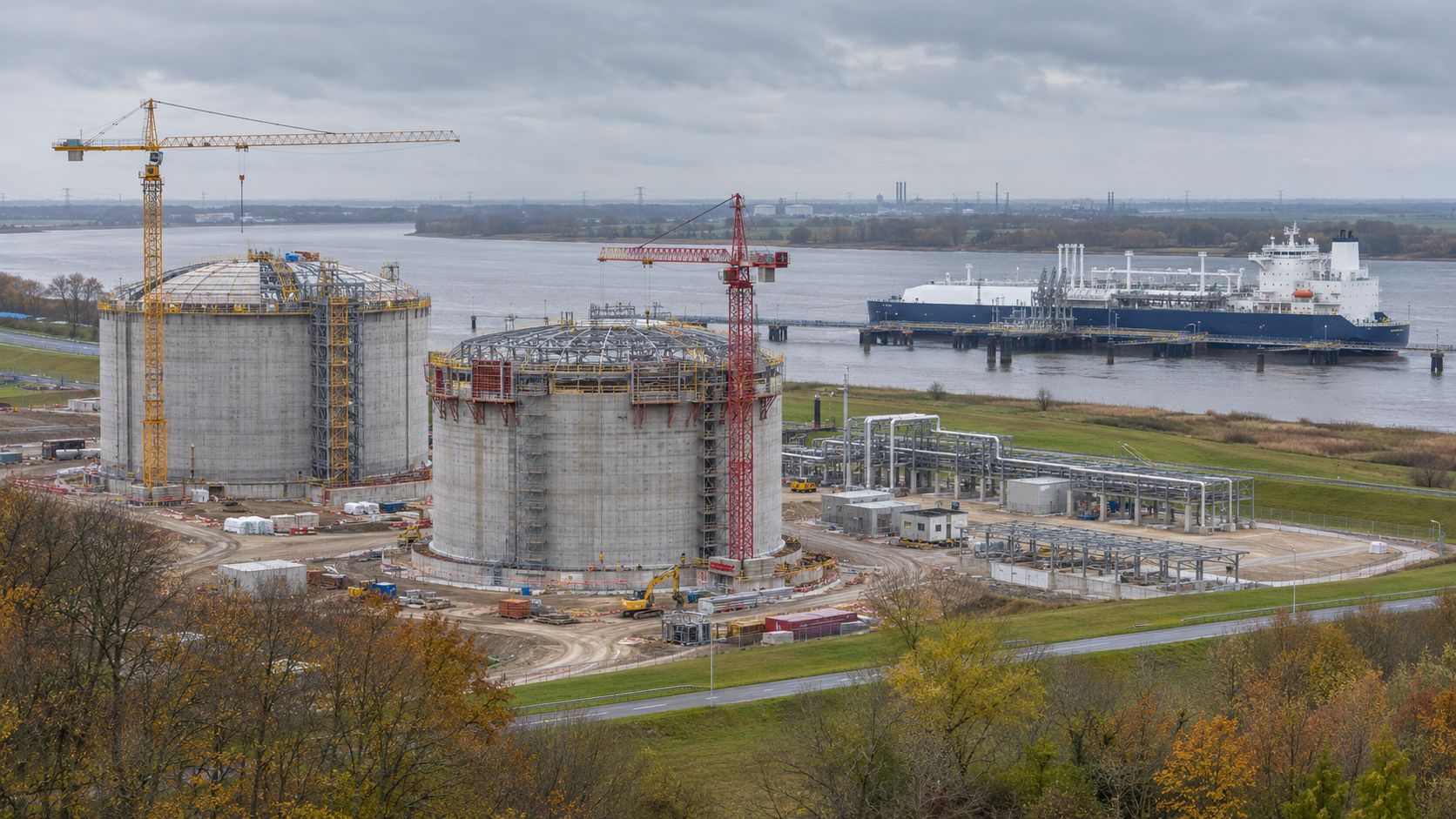
FSRU send-out in 2026 is a grid event. Truck and bunker loading, if it comes, starts with the shore plant in 2029.
Northern Germany still loads most small-scale LNG at Gate, Zeebrugge and French terminals. Stade, on the Elbe, is the first German site designed to shorten that haul — but not before the onshore terminal starts in 2029.
1. Two assets, one site
At Stade-Bützfleth the floating and the shore projects are not the same product.
Deutsche Energy Terminal’s FSRU Energos Force (174,000 m³, built 2021) berthed on 15 September 2026. DET has guided a first full cargo for early November. Send-out is about 1.7 bcm through the end of 2026 and up to 3.2 bcm in 2027 on a technical maximum, not a guaranteed volume. The unit regasifies into the grid. It does not open a truck rack or a bunker trade.
The onshore terminal is Hanseatic Energy Hub (HEH): Buss Group, Partners Group, Enagás (operator, 15%) and Dow. FID was taken in March 2024; construction started in June 2024. Start-up, first set for 2027, is now expected in 2029. The FSRU is due to leave once the shore plant is in service.
2. Onshore terminal in brief
| Item | Figure |
|---|---|
| Regasification | up to 13.3 bcm/year |
| Peak send-out | 21.7 GW |
| Storage | 2 × 240,000 m³, ammonia-ready |
| Long-term bookings | ~12 bcm (EnBW, SEFE, ČEZ) |
| Short-term balance | ~1.3 bcm |
| Status | under construction; start 2029 |
About 90% of regas capacity is already with large offtakers. In October 2026 HEH offered further long-term capacity from 1 September 2030. Regasification is planned on waste heat from the neighbouring Dow plant, with no own CO₂ on that step. Bio-LNG and synthetic methane are admitted from day one. The tanks are ammonia-ready.
3. What this does for ssLNG
Small-scale LNG is liquid moved by road tanker, rail tank or small vessel — not gas in the pipe. German FSRUs closed the pipeline gap after 2022 and left the liquid chain on Dutch, Belgian and French loading racks.
HEH’s concept includes a small-scale jetty for bunker vessels and small carriers, truck loading and, later, rail loading. The site is on the Elbe, close to Hamburg, two motorways and the Maschen yard. Q-Max carriers (up to 345 m) can use the main berth. Access is planned as open to third parties.
If those services open with the 2029 start, the effect in the region is real, even if it stays secondary to grid gas:
- Shorter haul. For Lower Saxony, Hamburg and Schleswig-Holstein, a truck from Stade is hours rather than a run to Rotterdam or Zeebrugge. That cuts cost and winter reliability risk.
- Shore storage. Two 240,000 m³ tanks can hold liquid for small parcels. An FSRU keeps inventory mainly for grid send-out.
- Bunkering beside Hamburg. Small bunker vessels can load at Stade and serve Hamburg, the Elbe and traffic toward the Kiel Canal.
- Bio-LNG and e-methane on the same jetty. Drop-in green methane matters more for trucks and ships than for the grid. FuelEU and renewable-fuel quotas bite there first.
4. What it will not do
Until 2029, Stade does not add ssLNG availability. The FSRU start is a security-of-supply event for the grid.
The core business is large-scale import. Roughly 90% of regas capacity is contracted to utilities. HEH has not published truck-bay numbers or an annual small-scale throughput. Rail loading is a later option, not a day-one service. Without it, eastern Germany and Czechia stay on the pipe — ČEZ’s booking is grid capacity — not on a virtual pipeline of tankers.
Gate and the Belgian and French terminals already run truck racks. Stade wins where distance and Hamburg bunkering decide, not where the buyer only wants the cheapest European spot slot.
Further out, contracts beyond ten years include an ammonia option, and the plant is ammonia-ready. If hydrogen offtake grows faster than gas, part of the storage and berths can leave LNG. That is a late-2030s risk, not a 2029 one.
Conclusion
For pipeline gas, Stade is another large entry point: an FSRU from autumn 2026, then an onshore plant of 13.3 bcm/year. For small-scale LNG the shore terminal is a different event. If the small-scale jetty, truck loading and bunkering open with the 2029 start, northern Germany gets its own liquid source beside Hamburg, the Elbe and the Kiel Canal. Availability improves through shorter logistics and local storage, not because the terminal’s capacity is redirected into the small-scale book. Until start-up, and until loading parameters are published, that is a grounded scenario, not an open market.