
by Eurolng.com Staff
Czech Republic: Biomethane Production, Transport Use and Small-Scale LNG Outlook
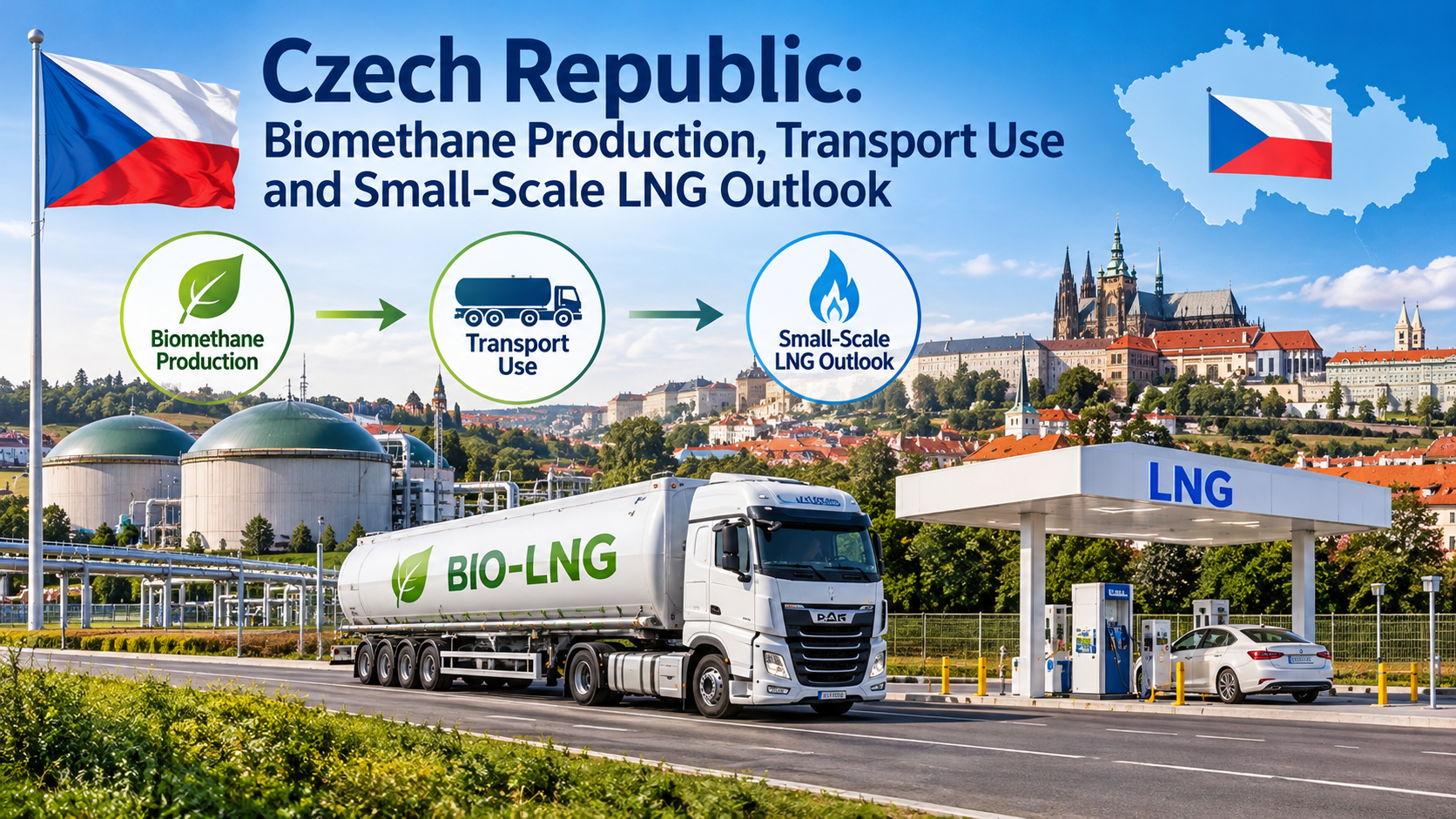
Market analysis as of November 2026
The Czech biomethane market is entering a rapid growth phase. Production remains modest today, but a large state-backed support programme, new auctions and expanding Bio-LNG retail infrastructure are reshaping the outlook for both transport and off-grid industrial use.
1. Biomethane Production
Current output is still limited, yet the market is scaling quickly under strong policy support.
Key figures (end-2025 / 2026):
- Operating plants: 13 biomethane stations (end-2025)
- Production volume: ≈ 17–17.2 million m³ in 2025
- Largest producer: ZD Dobruška (up to ~3 million m³/year)
- Active developers: EFG group (Rapotín and other projects)
Policy targets and support
The national 2030 target is almost 500 million m³ of biomethane per year. The European Commission has approved a Czech support scheme worth €3.7 billion. Support is delivered mainly through Contracts for Difference (CfD) auctions:
- First auction (2026): support for ~42–45 million m³/year (11–12 projects)
- Second auction announced in November 2026: another ~45 million m³/year
- Further rounds planned through 2028, targeting up to ~350 million m³ of new capacity in total
Most new biomethane is expected to be injected into the GasNet distribution network.
2. Use in the Transport Sector
Actual physical consumption of biomethane in transport remains relatively small. The majority of volumes enter the gas grid and are accounted for in transport via Guarantees of Origin (certificates).
Gas consumption in transport (CNG + LNG), 2025:
- Total: ≈ 96–100 million m³ (slight decline of ~4 % year-on-year)
- CNG/bioCNG buses: ~1,920 units
- LNG trucks: fewer than 200 units
2030 targets (National Clean Mobility Plan)
- ~2,530 CNG/bioCNG buses
- ~4,000 LNG/bioLNG trucks
- Biomethane use in transport: indicative range 110–300 million m³
Key challenge: biomethane production is growing faster than transport demand. Without stronger incentives for gas trucks and buses, a large share of new volumes will flow into heating and industry rather than road transport.
3. Bio-LNG Retail Network
Bio-LNG is already commercially available in the Czech Republic.
- GasNet is the first and main operator. Since November 2023 it has been offering bioLNG at all its stations.
- GasNet network: 6 public LNG/bioLNG stations located along major motorways (D1, D5, D8, D10, D11) and towards Austria.
- Shell also supplies 100 % BioLNG at its LNG stations (Svatá Kateřina on D5 and Dobšice).
Existing LNG trucks can refuel Bio-LNG without any technical modification. When advanced biomethane is used, CO₂ emissions can be up to 95 % lower than diesel.
4. Small-Scale LNG for Industrial Customers
The Czech small-scale LNG (ssLNG) market is developing, but remains primarily oriented towards transport rather than industry.
Current industrial picture:
- Main application of ssLNG is still truck refuelling.
- For industrial users (replacing fuel oil, LPG or diesel at sites without gas-grid connection) the market is at an early stage.
- Typical supply model: road tanker delivery + on-site regasification (satellite LNG).
- Czechia has no large-scale LNG terminal of its own; volumes arrive mainly via neighbouring countries (Poland, Germany, Croatia/Krk) or through virtual arrangements.
Growth drivers
- Rising carbon costs and the approach of ETS2
- Corporate need to cut emissions and meet ESG requirements
- Opportunity to switch from fuel oil / diesel / LPG to a cleaner fuel without a grid connection
Constraints
- Relatively dense gas network reduces the need for off-grid solutions compared with less gasified regions of Eastern Europe
- High capital cost of cryogenic equipment
- Still limited supply and competition from pipeline gas plus grid-injected biomethane
5. Summary Outlook
| Indicator | Current status (end-2025 / 2026) | 2030 outlook |
| Biomethane production | ~17 million m³ | Target ~500 million m³ |
| Transport use | Limited (mainly via certificates) | Potential 100–300 million m³ |
| Bio-LNG stations | GasNet 6 stations + Shell | Further network expansion |
| ssLNG for industry | Early stage | Moderate growth expected |
Bottom line
Czechia is rapidly scaling biomethane production through successive CfD auctions. The critical question for the coming years is whether the transport sector — especially heavy-duty trucks — can generate enough demand in time. If it does not, a substantial share of the new volumes will be absorbed by the gas grid, heating and industry instead of road transport.
For small-scale LNG suppliers and industrial off-takers, the Czech market remains secondary to transport today, but the combination of rising carbon costs, ESG pressure and the growing availability of Bio-LNG creates a clear medium-term opportunity for satellite LNG solutions at sites without pipeline access.
Sources & notes