
by Eurolng.com Staff
Small-scale LNG market in Greece: growth drivers, players and volumes
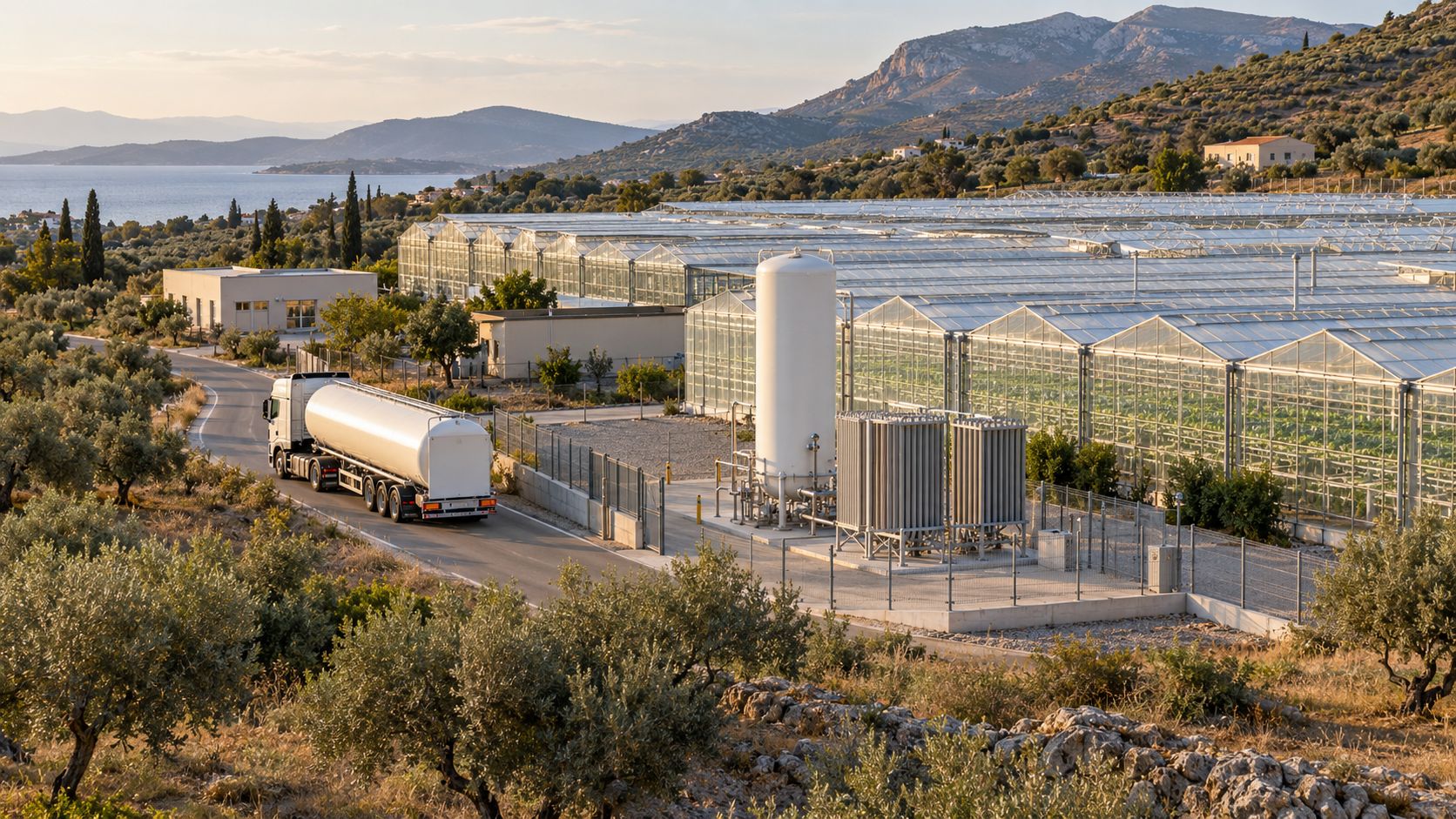
Revithoussa, truck loading and off-grid supply — 2024–2026
Greece entered the small-scale LNG market relatively late, but growth since 2024 has been sharp. The system centres on the Revithoussa terminal (DESFA) with the first truck-loading station in South-Eastern Europe. Main demand comes from industry and remote networks outside the main gas grid. On the commercial side, European player Molgas has been active since 2022 through the acquisition of local company Blue Grid.
1. Infrastructure: Revithoussa as the hub
The Revithoussa terminal (island near Megara, ~45 km from Athens) is Greece’s main LNG import hub. Since November 2023 a Truck Loading Station has been in operation — the first such facility in South-Eastern Europe.
- Truck loading → a “virtual pipeline” to off-grid customers.
- A second loading bay is planned (higher throughput).
- In prospect: a small-scale jetty for ship bunkering and supply of satellite stations.
2. Volumes: rapid growth in truck loading
| Year | Truck loadings (Revithoussa) | Comment |
|---|---|---|
| 2023 | 9 | Commercial start (from November) |
| 2024 | 259 | First full year of growth |
| 2025 | 707 | Almost 3× vs 2024 |
| 2026 (to May) | More than 2× same period 2025 | Acceleration continues |
Industry estimates put about 78% of truck-loading volumes into domestic industry and remote networks. The rest includes deliveries to neighbouring Balkan markets that lack large-scale LNG infrastructure of their own.
3. Growth drivers
- Off-grid industry. Sites outside the gas grid (greenhouses, food processing, CHP) switching from oil products to LNG.
- Remote towns and islands. Satellite regasification stations (e.g. Aspro in Central Macedonia) supply local networks and end users.
- DESFA’s role. The operator is building out the ssLNG chain under its ten-year plan: second bay at Revithoussa, new regional sites, bunkering in prospect.
- Regional hub. Greece positions Revithoussa as a supply point for the Balkans, where comparable small-scale infrastructure is scarce.
4. Main players
| Player | Role |
|---|---|
| DESFA | Operator of Revithoussa, truck loading, satellite stations; key ssLNG infrastructure player |
| Molgas (Blue Grid) | Entered the Greek market in 2022 via acquisition of local company Blue Grid; develops commercial ssLNG supply and off-grid solutions |
| DEPA Commercial | CNG/ssLNG supply to industry; regasification projects (e.g. greenhouses in Serres) |
| Industrial customers | Main demand: food processing, greenhouses, CHP, local networks |
| Large-scale import (background) | Revithoussa + Alexandroupolis FSRU — source of molecules; ssLNG is the distribution channel |
Molgas is one of Europe’s leading small-scale LNG and Bio-LNG players (refuelling network, bunkering, industrial supply). Entering Greece via Blue Grid in 2022 gave the company a local platform to develop ssLNG in parallel with DESFA’s infrastructure build-out.
Greek shipowners dominate the global LNG carrier fleet, but that is a separate segment (ocean shipping), not the domestic ssLNG market.
5. Outlook and constraints
Growth in truck loadings from single digits to hundreds of runs a year shows that the “virtual pipeline” model is in demand. Further expansion depends on:
- loading capacity at Revithoussa (second bay);
- the number of satellite stations and industrial demand;
- small-scale bunkering (jetty at Revithoussa) and supply to the islands.
6. Conclusion
Greece’s ssLNG market is young but growing fast: from 9 truck loadings in 2023 to 707 in 2025, with further acceleration in 2026. Drivers are off-grid industry, remote networks and Revithoussa’s role as a regional hub. Key players are DESFA (infrastructure), Molgas (via Blue Grid, since 2022) and DEPA Commercial (supply). For the European ssLNG segment, Greece illustrates how one truck-loading point, a network of satellite stations and the entry of an international commercial operator can build a meaningful domestic market within a few years.