
by Eurolng.com Staff
TTF prices and ssLNG logistics: what is changing for buyers
Late September 2026 review | How the final price is formed
The European TTF benchmark has settled in the €71–73/MWh range in recent days after correcting from levels around €80. For small-scale LNG buyers this means a moderate reduction in the final price under formula contracts. At the same time it is important to understand how the logistics component is formed today — it remains relatively stable.
1. TTF dynamics in recent days
| Date | TTF (€/MWh) | Trend |
|---|---|---|
| 25 Sep | ~70.5–72 | Decline −5–6% |
| 26–27 Sep | ~72–73 | Stabilisation |
| 28–29 Sep | ~71–73 | Narrow range |
Over the week the price fell by roughly 7–8% from levels around €80. EU gas storage stands at about 71% (below normal). The market remains sensitive to supply news and weather.
2. Impact on small-scale LNG buyers
| Factor | What it means for the buyer |
|---|---|
| TTF down 7–8% | Under “TTF + premium” formulas the final price eases moderately. Relief is real, but the level remains high |
| €71–73 range | Competitiveness versus fuel oil/LPG improves only moderately. A fall below €70 would have a stronger effect |
| Volatility | Fixed prices are risky. Formula contracts (TTF + coefficient/premium) remain preferable |
| Bio-LNG | PoS certificate (−100 gCO₂eq/MJ) currently around +€80/MWh. This significantly lifts the final price |
Practical takeaway: stick to formula pricing and lock volumes for the coming weeks if demand is firm. If TTF moves closer to €65–68, ssLNG competitiveness versus liquid fuels will improve markedly.
3. How logistics costs are formed today
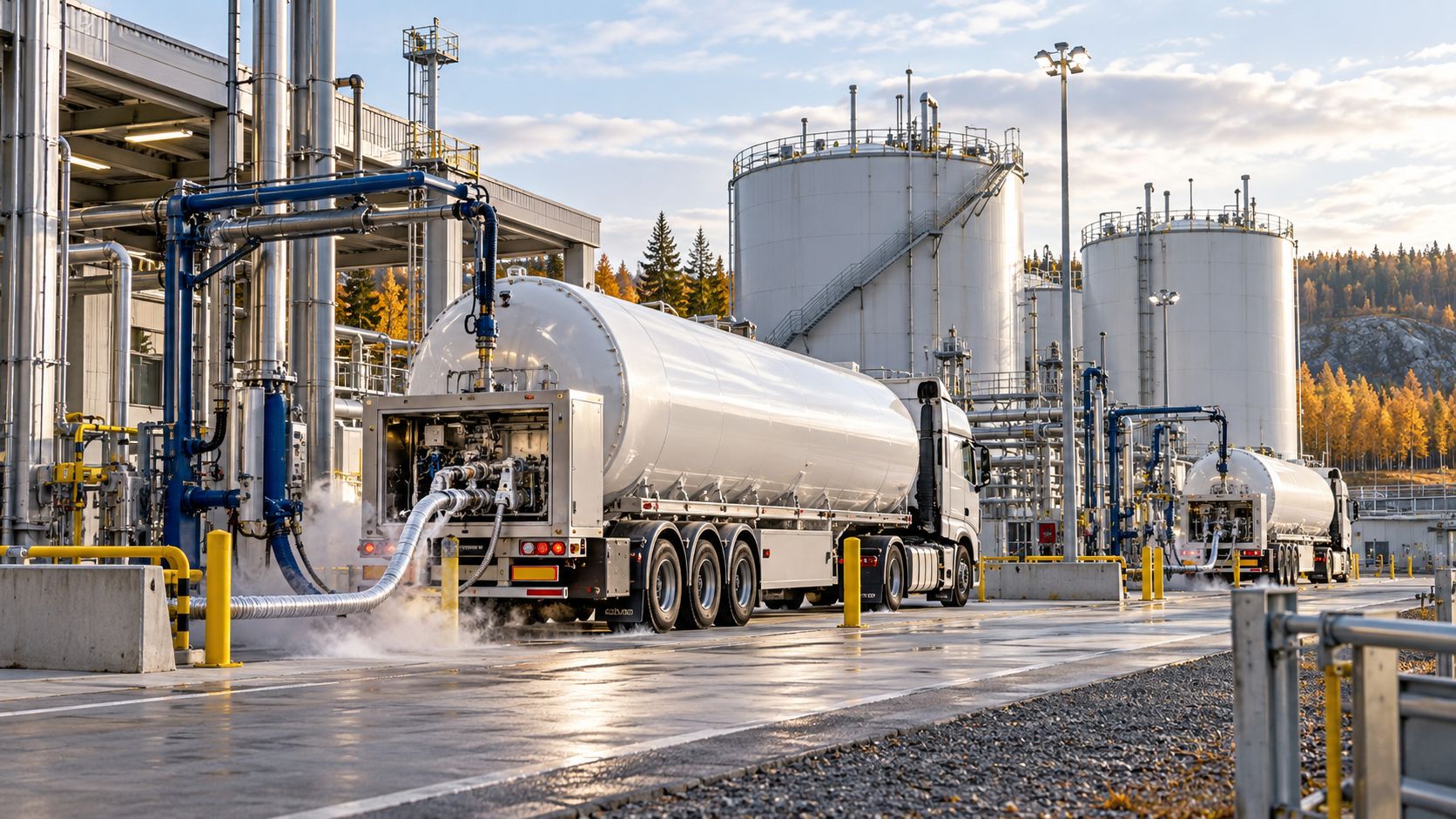
ssLNG is delivered in full road tankers. Typical market parameters:
- Payload: 18 tonnes of LNG
- Calorific value: 15.25 MWh/t → 274.5 MWh per load
- Carrier tariff (all-in): €1.90/km
- Working radius: normally up to 700 km from the loading point
Logistics cost at €1.90/km (round trip):
| Distance | Round trip (km) | Trip cost | €/MWh |
|---|---|---|---|
| 200 km | 400 | €760 | 2.8 |
| 300 km | 600 | €1,140 | 4.2 |
| 400 km | 800 | €1,520 | 5.5 |
| 500 km | 1,000 | €1,900 | 6.9 |
| 600 km | 1,200 | €2,280 | 8.3 |
| 700 km | 1,400 | €2,660 | 9.7 |
Formula:
Logistics (€/MWh) = (2 × distance_km × 1.90) / 274.5
4. How the final ssLNG price is built
Typical structure:
- Molecule (TTF) — ~€71–73/MWh
- Supplier premium — usually €20/MWh (include loading terminal fee)
- Logistics — €3–10/MWh (depending on distance)
- Bio-LNG (PoS −100 gCO₂eq/MJ) — additional ~€80/MWh
Example (TTF = €72, premium €20, 500 km delivery range):
- Conventional ssLNG: 72 + 20 + 6.9 ≈ €98,90/MWh
- Bio-LNG: 72 + 20 + 6.9 + 80 ≈ €178,90/MWh
5. Conclusion
TTF has corrected to €71–73/MWh — giving a moderate reduction in final prices for buyers on formula contracts. Logistics at €1.90/km and a 18 t load (274.5 MWh) ranges from ~€3 to ~€10/MWh depending on distance (up to 700 km). The main contributors to the price remain the molecule and the supplier premium; for Bio-LNG the expensive PoS certificate (~€80/MWh) remains critical.