
by Eurolng.com Staff
Gothenburg has a tank. Most new Bio-LNG will not look like it
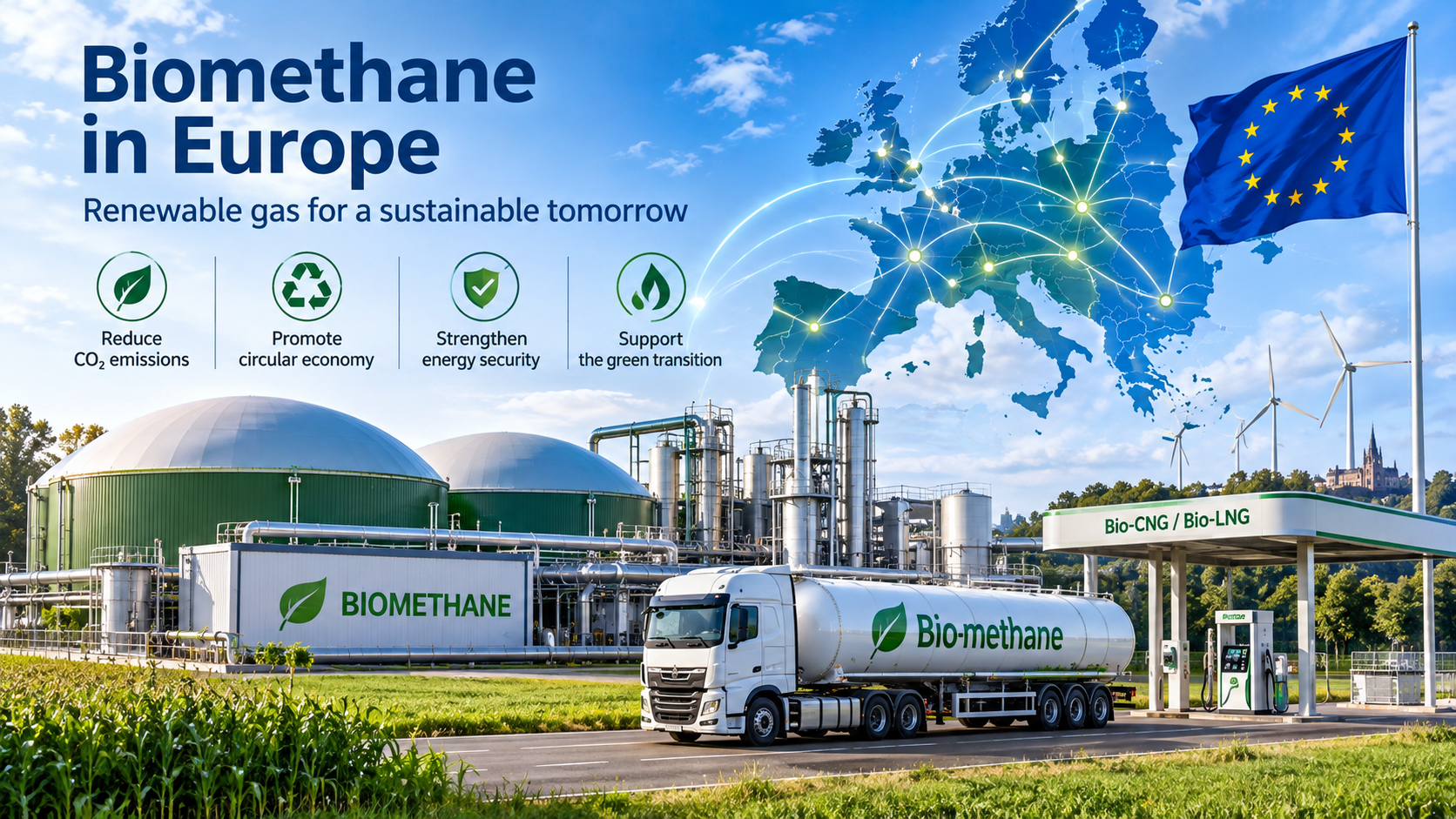
Nordion Energi’s grid-connected plant is due in the second quarter of 2027. The rest of the European build is smaller, later, and mostly not a bunker stem.
On 12 November the Port of Gothenburg installed the first major piece of equipment at Nordion Energi’s liquefied biogas plant: a 500 m³ tank, close to 140 tonnes, able to hold about 200 tonnes of bio-LNG. Foundations are done. The port expects the plant online in the second quarter of 2027, at 250 GWh a year, about 50 tonnes a day — the fuel of roughly 500 trucks, or the bunkering of about 50 ships.
That is a real construction milestone. It is not evidence that Europe is now building a fleet of port-side bio-LNG plants. Gothenburg is one model. Most of the capacity still going into the ground is a different one.
1. What this plant actually is
Construction started in May 2026. Nordion Energi owns the facility. It will be the first liquefaction plant in Sweden tied directly to the west Swedish gas grid. The point is not a new digester at the quay. The point is an outlet for biogas producers already on the network, or willing to connect, so their gas can reach ships, trucks and industry beyond the pipe.
St1 Biokraft has already booked part of the capacity. Several lines that call Gothenburg already burn liquefied biogas. The port’s own framing is bunkering. The plant’s framing is wider: shipping, heavy road transport and industry, from one grid-connected unit.
For a small-scale book, 50 tonnes a day is a useful plant, not a new supply basin. Two weeks of nameplate output fills the tank. The commercial question is who has the offtake, not whether the tank is in.
2. The market around it
Europe’s installed biomethane capacity reached 8.2 bcm a year at the end of the second quarter of 2026, up 17% on 2025, past 8 bcm for the first time. Plant count rose from 1,678 to 1,975. Three hundred and twenty-seven plants were commissioned. Average size is 472 Nm³/h. Five countries still account for 95% of European biomethane production.
Committed investment in the EBA’s July outlook is €36 billion, up from €28 billion, and is associated with about 9 bcm a year of extra European capacity by 2030 if it is all built. The near slice is much smaller: €3.3 billion and 0.8 bcm tagged to 2025–2026. The bulk, €22.4 billion and 6.2 bcm, sits in 2027–2030.
The capital is concentrated. Denmark €8.7 billion, Italy €4 billion, Spain €3 billion, the UK €2.6 billion, France €2.4 billion. Almost all of that money is for biomethane into a grid or a national certificate scheme. Liquefaction is the exception.
A Guidehouse study puts EU-27 biomethane potential at 31–32 bcm in 2030. Installed European capacity is 8.2 bcm. The gap is not a construction schedule. It is permits, feedstock and a support system that is being rewritten while the plants are poured.
3. Where something is actually being built
Status matters more than the headline. “FID”, “technology selected” and “tank installed” are not the same cargo.
|
Country |
What is moving |
Status, November 2026 |
Product |
| Sweden | Gothenburg, Nordion Energi, 250 GWh, ~50 t/day | Tank in, online Q2 2027 | Grid biomethane, then liquefied |
| Sweden | Gasum Borlänge, 120 GWh LBG, SEK 700 million | Near complete; commissioning slipped after the main contractor’s bankruptcy on 9 October | On-site bio-LNG |
| Sweden | Vara, EnviTec digestion, Nordsol liquefaction | Construction advancing, timetable to early 2027 | On-site bio-LNG, plus CO₂ capture |
| Sweden | Gasum Hörby and Sjöbo | FID taken; groundworks pushed back from early 2027 | Planned on-site LBG |
| Italy | National bio-LNG fleet | 29 plants and 80,000 t in 2025; BIP/Assogasliquidi expect 38 plants and 94,000 t during 2026 | Mostly on-site bio-LNG |
| Italy | PNRR biomethane | 250 plants and 1.33 bcm last year; estimate up to 683 plants and 2.92 bcm as funded units commission | Mostly grid biomethane |
| Spain | Cobirgy, Naturgy/ID Energy, Moeve | FID and multi-plant programmes; Cobirgy above 230 GWh | Grid biomethane, not liquefaction |
| France | Injection plants, plus one farm unit | Feed-in tariff tightened in August 2026; Sublime Energie’s Plélo demonstrator inaugurated in April | Grid gas; one on-farm liquefaction demo |
| Netherlands | Grid, not tanks | 60 km of pipe repurposed for biomethane; blending obligation from 2027 | Grid biomethane |
| Poland | First bio-LNG unit, Nord Gas, 35 t/day | Contract in September 2026, brownfield, work to start | On-site bio-LNG |
| Norway | Havila Biogass, three sites, ~100 GWh each | Technology partner selected in November 2025, start targeted 2027/28 | Planned bio-LNG, not a 2026 construction report |
Sweden is the only country where several bio-LNG liquefaction projects are visibly in the ground at once.
Borlänge was meant to commission in mid-October. On 9 October Lundsby Renewable Solutions, Gasum’s main contractor, filed for bankruptcy. Gasum now aims to start commissioning around the turn of the year. Götene, the previous plant in that series, is already complete. Hörby and Sjöbo have an investment decision and a delayed start.
At Vara, EnviTec is building digestion and upgrading for Biogas Västra Skaraborg. The liquefaction unit is Nordsol’s, outside EnviTec’s scope, with a timetable into early 2027 and a CO₂ capture add-on.
Italy is the volume story, and it is mostly not liquefaction. The bio-LNG estimate — 38 plants, 94,000 tonnes — is a real addition, on the order of 1.3 TWh if the plants run. The biomethane estimate, toward 2.92 bcm, is an order of magnitude larger, and it is an estimate for plants financed under the recovery plan, not a count of units already injecting.
Spain has the feedstock and the pipe. Sedigas has put technical potential near 163 TWh. Copenhagen Infrastructure Partners has taken FID on Cobirgy in Catalonia, above 230 GWh. Naturgy and ID Energy have talked about 20 plants and 1,600 GWh. Moeve has put €600 million against 30 plants. None of that is a liquefaction schedule. A Spanish biomethane FID does not become a Gothenburg stem.
France leads Europe on plant numbers and trails on size, at an average 212 Nm³/h against Denmark’s 1,528. The August 2026 decree narrowed access to the guaranteed tariff and put the growth obligation onto gas suppliers through biogas production certificates. New French plants will be built. They will inject. The exception is small and already open: Sublime Energie’s on-farm liquefaction demonstrator at Plélo, inaugurated in April 2026. A demonstrator is not a corridor.
The Netherlands is building the market design. The lower house has passed a green-gas blending obligation from 2027, and Gasunie with three distribution operators has turned 60 km of existing pipe into a biomethane collector into the transmission grid at Ommen. That pulls gas into the network. It does not pour a bio-LNG tank.
Poland and Norway are the early edge, and they should be labelled as such. Nord Gas Solutions has a contract for what it calls Poland’s first bio-LNG plant, 35 tonnes a day, a conversion of an existing biogas site, signed in late September, with work described as about to start. Havila Biogass selected Nordsol in November 2025 for three Norwegian plants of about 100 GWh each, aimed at 2027/28, plus a wider partnership toward 700 GWh. No public construction milestone since then matches Gothenburg’s tank. Until one does, those tonnes are a target.
Germany does not belong in the construction table on current evidence. It belongs on the demand side. Bio-LNG has already taken the fossil molecule off a large part of the German filling-station network. The policy change under way is about how biomethane is supported, not about a new port plant.
4. Two products, sold as one name
The build splits into two.
On-site liquefaction. Digester, upgrading, a small liquefier, a tank, a trailer. Italy’s existing fleet, Borlänge, Vara, the Polish brownfield, the Norwegian plan. Scale is 6–50 tons a day, sometimes less. The second product, if it is captured, is biogenic CO₂. This is the plant a truck supplier can contract against.
Grid liquefaction, and its virtual cousin. Gothenburg takes biomethane that is already in the west Swedish grid and liquefies it at the port. Zeebrugge and Klaipeda go one step further: the biomethane stays in the network, and the Proof of Sustainability is attached to LNG already in the tank. Certified bio-LNG reached a European port this way in March 2026, when a Klaipeda cargo moved on to Destination Gotland.
Both can be ISCC-certified. They are not the same offer. One is a molecule made at a named plant. The other is an attribute moved onto a fossil cargo, lawful only if the terminal is in the interconnected EU grid and certified as the processing unit. A buyer who needs a waste-based, plant-specific GHG number cannot treat a mass-balance stem as a substitute just because both say bio-LNG.
Gothenburg sits between them. The gas is grid gas, so it is not one farm’s manure. The liquefaction is physical, at the port, so the ship is not depending on a certificate transfer at a distant FSRU. That is why the plant matters for bunkering, and why it does not add a new biomethane basin.
5. Why the plants still get built at a premium
Demand is being written into law faster than plants are being poured.
FuelEU Maritime has applied since 2025, with a pooling mechanism that pays for over-compliance. Shipping is already signing. MOL has bio-LNG cover with Axpo and Titan for car carriers in northern Europe and the Mediterranean. ETS2, with EEX auctions from 18 January 2027, puts a carbon price on fuel burned in buildings and road transport. The Dutch blending obligation starts the same year. France has moved suppliers onto certificates. The Commission’s first biomethane matching round is open until 23 December, with results due on 18 March 2027.
None of these schemes require the buyer to wait for Gothenburg. They do require a certificate the scheme will accept. That is why a cargo can clear at a multiple of fossil LNG and still find a shipowner. DNV’s late-2025 reading was that liquefied biomethane in Rotterdam was about three times fossil LNG, and competitive on selected EU–EU voyages only after ETS exposure and FuelEU pooling. That ratio will move with TTF. The structure will not. In a high-TTF winter the compliance stack is often easier to defend than an uncovered fossil stem. It is not a discount to TTF.
The constraint on the other side is physical. EBA’s own line is that regulatory complexity is holding the sector below its potential. The Borlänge bankruptcy is the practical version: a plant can be financed, permitted and almost finished, and still miss the month on the slide. Feedstock contracts, grid injection queues and a support scheme that changes mid-build do the same job more quietly.
Takeaway for the ssLNG market
- Treat 2027 Swedish tonnes as the firm physical addition: Gothenburg from the second quarter, Borlänge if commissioning around year-end holds, Vara if the early-2027 timetable holds. Book against the plant, not against “Scandinavian bio-LNG”.
- Do not read Spanish, French or Danish investment headlines as liquefied cargo. Those programmes inject. Liquefaction, if it comes, is a second decision.
- Keep physical bio-LNG and mass-balance bio-LNG in separate columns. Klaipeda and Zeebrugge already clear the second. Gothenburg will add the first, at a port ships already use. The GHG number, the feedstock and the eligibility under FuelEU or a national quota are not interchangeable.
- Poland at 35 tonnes a day and the Norwegian trio are options, not 2027 supply, until there is a construction date rather than a contract or a technology award.
- The premium stays. More plants do not mean a cheaper stem. They mean more named origins, more commissioning risk, and a wider gap between a certificate and a trailer.