
by Eurolng.com Staff
TTF VS HENRY HUB: WHY THE EUROPEAN PREMIUM PERSISTS
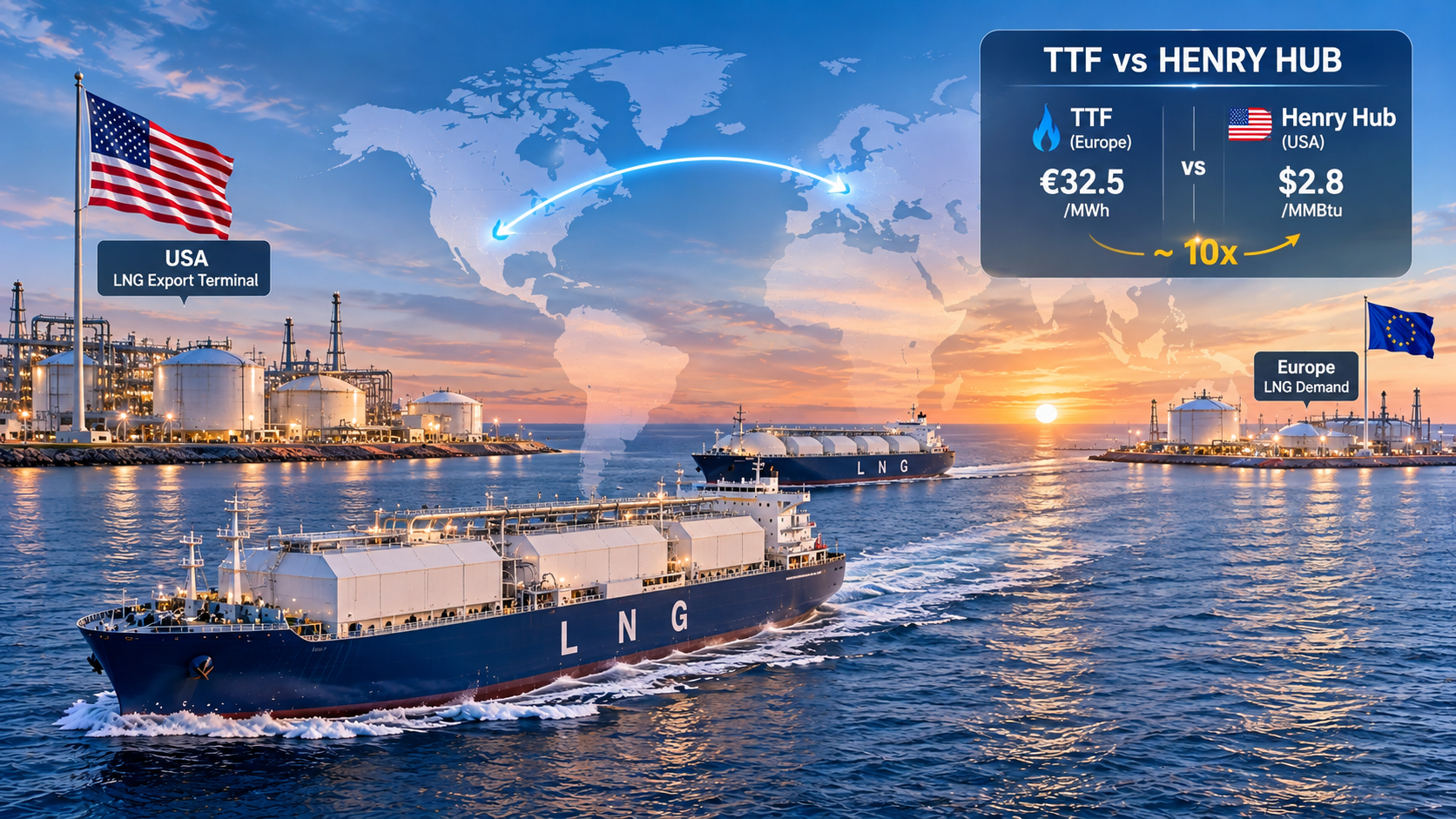
Henry Hub near $3.3/MMBtu, TTF near €88/MWh. On a comparable basis the European benchmark still trades at roughly eight to nine times the US price. The gap is structural, not temporary.
Europe’s main gas price reference remains the Dutch TTF. North America’s is Henry Hub. Both are liquid, both settle futures, and both are used in LNG contracts. They do not price the same molecule in the same place, and they almost never trade at parity.
- The two benchmarks side by side
| Feature | Henry Hub | TTF |
| Location | Physical pipeline interchange, Erath, Louisiana | Virtual trading point, Netherlands |
| Region | United States / North America | Northwest Europe (and Europe by extension) |
| Quote | USD/MMBtu | EUR/MWh |
| Supply base | Domestic shale and associated gas | Pipeline imports + regasified LNG |
| Main drivers | US weather, storage, production, export demand | Storage, weather, LNG arrivals, wind generation, geopolitics |
| Typical volatility | Lower | Higher |
Henry Hub is a physical hub where pipelines meet. TTF is a virtual point inside the Dutch gas network. One prices abundant domestic pipeline gas; the other prices the cost of attracting the marginal cargo into an import-dependent market.
- Current levels (mid-November 2026)
- Henry Hub front-month: approximately $3.25–3.50/MMBtu.
- TTF front-month: approximately €87–89/MWh.
Conversion rule of thumb: €/MWh ÷ 3.412 × EUR/USD ≈ $/MMBtu.
At current exchange rates TTF converts to roughly $28–30/MMBtu. The gross transatlantic spread remains wide — well above the long-run cost of liquefaction, shipping and regasification.
- Why the premium holds
Supply elasticity differs. The United States can respond to higher prices with more drilling. Europe cannot; it can only bid harder for existing cargoes.
Contract mix differs. A large share of European LNG still arrives on a spot or gas-indexed basis. Much of East Asia’s long-term book remains oil-linked. When supply tightens, Europe clears the market first.
Logistics friction is permanent. Liquefaction, Atlantic freight, boil-off and regasification add several dollars per MMBtu. US terminals running near capacity cannot close the gap overnight.
Asia remains the alternative buyer. When the Japan-Korea Marker (JKM) netback exceeds the European netback, flexible cargoes turn east. Europe must outbid that alternative or lose the ship.
A mild European winter or a temporary improvement in storage can pull TTF lower for a few weeks. It does not remove the structural premium.
- What the spread means for US LNG and European buyers
The TTF–Henry Hub spread is the core arbitrage signal for US LNG exports. When the converted spread comfortably exceeds liquefaction and freight costs, cargoes flow to Europe. When it compresses, some volume stays domestic or moves to other basins.
For European buyers the implication is straightforward:
- Henry Hub indexation is not a free hedge. Higher feedgas demand can lift the US price even while new liquefaction eventually eases TTF.
- Spot TTF remains the marginal price for uncontracted volume.
- New US and Canadian trains scheduled for 2027–2028 are the main volume that can structurally reduce the European premium — provided the plants actually start.
- Takeaway for the ssLNG market
Small-scale LNG and Bio-LNG formulas still track TTF front-month plus premium plus logistics. The absolute level of the base molecule matters more than the theoretical Henry Hub netback.
Practical points:
- Treat the current TTF range (€85–90/MWh zone after the early-November correction) as a better entry for formula discussion than the €100+ prints of late October, but not as a return to cheap spot.
- Volume and timing still need fixing ahead of delivery. Logistics and terminal access premiums do not disappear when the benchmark falls.
- Bio-LNG continues to price off a different stack (certificates, GHG saving, quota). In a high-TTF environment that stack is often easier to defend than an uncovered fossil spot cargo.
- Atlantic supply growth remains the only lever that can permanently compress the European premium. Until those cargoes are on the water, the TTF–Henry Hub gap stays a structural feature of the market, not a temporary dislocation.