
by Eurolng.com Staff
LNG in Norway: Hammerfest, Equinor and the EU market
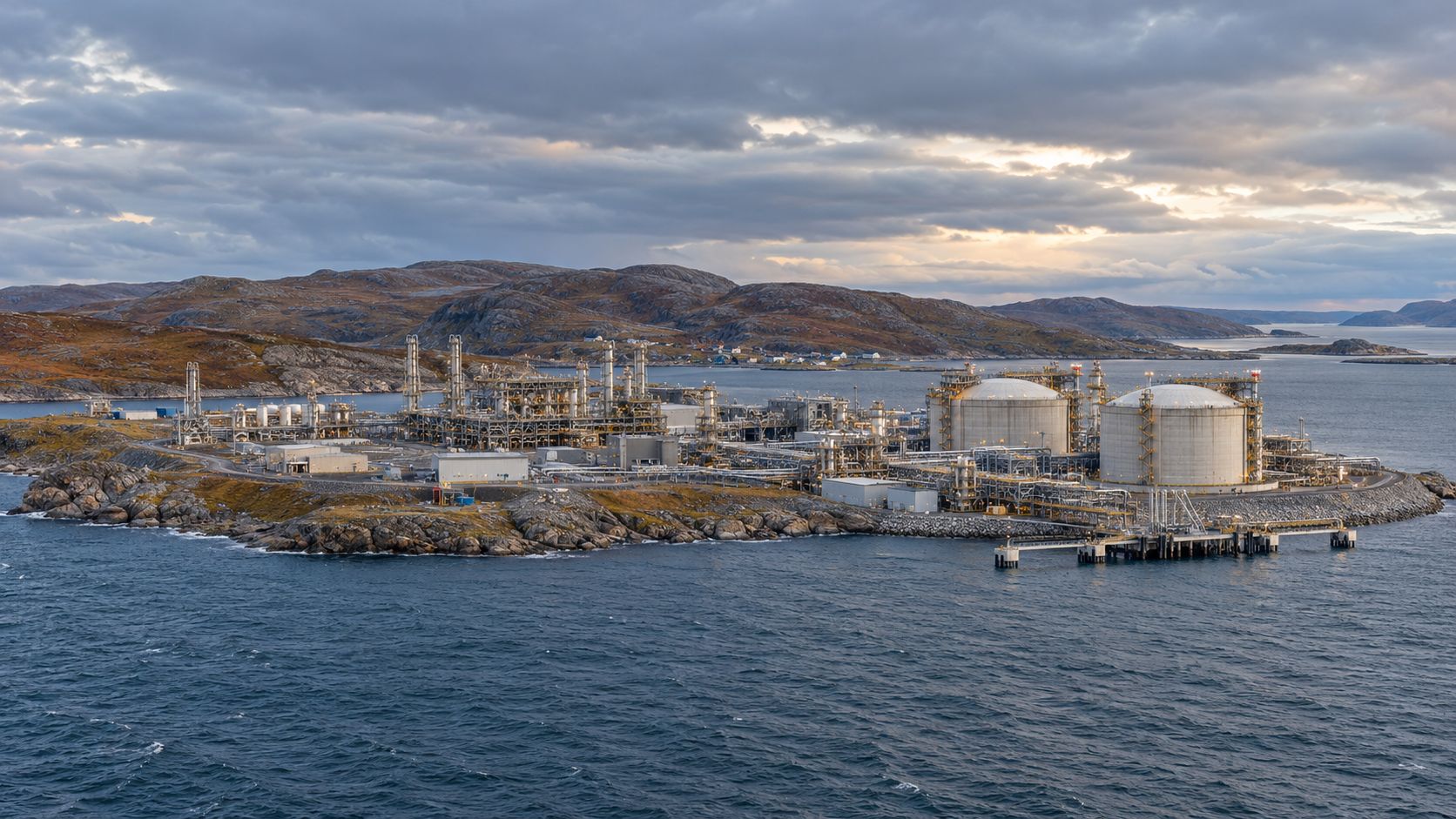
Northern Europe’s only major LNG plant, the Snøhvit Future project and Equinor’s strategy
When people talk about Norwegian gas, they usually mean pipelines: about 115 bcm in 2025, nearly a third of Europe’s imports. Norway also has another, less visible but strategically important asset — the Hammerfest LNG plant on Melkøya island, north of the Arctic Circle. It is the only major commercial LNG terminal in Northern Europe and the only one on the Norwegian continental shelf. The operator and key marketer is Equinor.
1. Hammerfest LNG: a plant at the edge of Europe
Melkøya lies near the town of Hammerfest, at almost 71° north. Feedstock comes from the Snøhvit field and related Barents Sea deposits via a subsea pipeline. Gas is liquefied on site and loaded onto specialised carriers — roughly every five days.
| Parameter | Value |
|---|---|
| Capacity | ~4.2–4.3 mtpa of LNG (about 6.5 bcm of gas) |
| Share of Norway’s gas exports | ~5% |
| Reference for the EU | ~2% of EU gas demand (Equinor estimate) |
| Ownership | Equinor ~36.8%; Petoro 30%; TotalEnergies 18.4%; Vår Energi 12%; Harbour Energy ~2.8% |
| Employment | ~700–750 on site; about 1,450 including ripple effects |
After a fire in 2020 the plant was shut down and later restarted. In 2025–2026 additional subsea fields (including Askeladd Vest) were brought on stream to maintain full utilisation until onshore compression under the Snøhvit Future project starts.
2. Snøhvit Future: extending life and cutting emissions
Without upgrades, Snøhvit output would decline and the plant would lose competitiveness. Snøhvit Future addresses both longevity and local emissions:
- Onshore compression (from 2029) — raises recovery (from about 45% towards 70% of reserves) and sustains a stable flow to the plant.
- Electrification (from 2030) — replaces gas turbines with power from the mainland grid. Expected CO₂ reduction: about 850,000 tonnes per year, or roughly 2% of Norway’s total emissions.
- Operating horizon — through 2050.
- Cost (October 2026 estimate): NOK 26.5 billion (~$2.8 billion) — well above the 2022 plan. The increase reflects the complexity of brownfield work in Arctic conditions. Project completion is around 60%.
3. Norway in the EU: pipelines dominate, LNG is a niche
Norwegian pipeline exports dwarf LNG volumes. In 2025 Gassco delivered about 115 bcm to Europe — roughly 30% of the continent’s natural gas imports. Norway remains the EU’s and the UK’s largest supplier of gaseous gas.
Hammerfest LNG exports are measured in a few million tonnes a year (a global share of less than 1%). For Northern Europe, however, it is the only major indigenous source of liquefied gas. Short voyages to North-West European terminals and occasional cargoes further south (including first deliveries to Croatia) offer a logistics edge over Atlantic and Middle East parcels.
With Qatari supply constrained and fierce competition for spot cargoes, even a relatively small but predictable flow from Hammerfest helps balance the regional market.
4. Equinor: operator, marketer and growing LNG portfolio
Equinor combines the role of Hammerfest LNG operator with that of a leading seller of Norwegian gas:
- Markets about 70% of all Norwegian gas exports.
- Natural gas sales in 2025: about 67 bcm (+6% year-on-year).
- Global LNG portfolio is expanding: target of 10–15 mtpa by the early 2030s. Hammerfest provides the base volume; long-term Cheniere contracts (US, about 3.5 mtpa) have already delivered first cargoes in 2026, alongside deals with European (Uniper) and Asian buyers.
- Trading infrastructure (MMP, Danske Commodities) allows optimisation across pipeline gas, spot and long-term contracts in Europe and beyond.
5. Implications for the ssLNG market
For small-scale LNG buyers in the Baltic, Scandinavia and Northern Europe, the Norwegian factor matters in several ways:
- Short logistics. Compared with US or Middle East cargoes, voyages from Hammerfest are shorter and less exposed to long-haul route disruptions.
- Carbon footprint. After electrification in 2030, Hammerfest emissions will fall sharply — strengthening the competitiveness of Norwegian LNG under ETS2, FuelEU and tighter reporting rules.
- Equinor’s role. The company shapes not only physical volumes from Melkøya but also parcel availability through its growing LNG portfolio and trading network.
- Supply stability. In a volatile global spot market, a relatively predictable North European source reduces risk for off-grid customers and regional bunkering.
6. Conclusion
Norway remains a cornerstone of European gas security through pipeline deliveries. Its LNG segment is concentrated at a single Arctic plant — Hammerfest LNG, with capacity of about 4.3 mtpa. Equinor, as operator and main marketer, anchors that role while expanding its global LNG portfolio. The Snøhvit Future project (compression from 2029, electrification from 2030) is intended to keep the plant running into mid-century and cut hundreds of thousands of tonnes of CO₂ a year. For the Northern European ssLNG market, Norwegian LNG is a niche but strategically valuable source: short logistics, a path to a lower carbon footprint, and the presence of a large, reliable seller.