
by Eurolng.com Staff
Production methods for LNG, Bio-LNG and E-methane
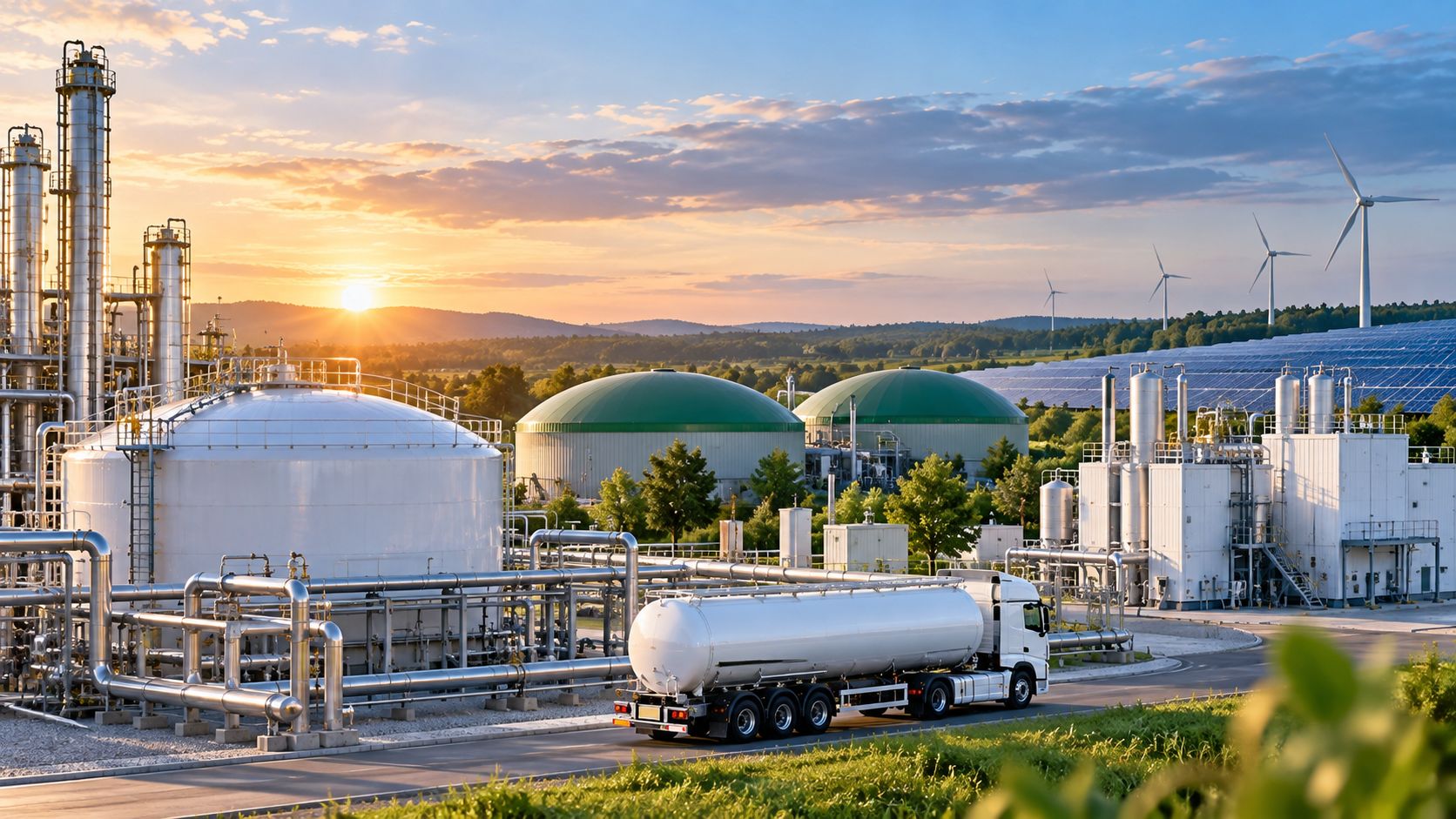
A comparative overview of technologies for the small-scale and renewable gas market
Three main product groups are developing in parallel on the liquefied gas market today: conventional (fossil) LNG, Bio-LNG (liquefied biomethane) and synthetic methane / e-methane (e-LNG). After liquefaction all three have virtually identical physical properties and can use the same storage, transport and bunkering infrastructure. The differences lie in feedstock, carbon footprint and production cost.
1. Conventional LNG (fossil LNG)
Feedstock is natural gas from fields. Main stages:
- Production and gas treatment (removal of CO₂, H₂S, water, heavy hydrocarbons)
- Liquefaction at approximately –160…–162 °C
- Storage in cryogenic tanks and loading
Liquefaction technologies include C3MR, AP-X, cascade and mixed-refrigerant processes. Small-scale plants often use simplified or nitrogen-based cycles. The carbon footprint is determined by upstream emissions and the energy used for liquefaction.
2. Bio-LNG (liquefied biomethane)
The most mature and commercially available “green” route. Typical chain:
- Anaerobic digestion of biomass (manure, food waste, residual biomass, silage) → biogas (CH₄ + CO₂)
- Upgrading — removal of CO₂, H₂S and water → biomethane (≥97 % CH₄)
- Liquefaction → Bio-LNG
Alternative: biomethane is injected into the gas grid and later withdrawn and liquefied elsewhere (mass-balance / book-and-claim).
Advantages: already operating at industrial scale, especially in Europe; with manure and waste feedstocks a very low or negative GHG profile is possible. The main constraint is the availability of sustainable feedstock.
3. E-methane / e-LNG (synthetic methane)
Produced via the Power-to-Methane route:
- Green hydrogen — water electrolysis using renewable electricity
- CO₂ source — biogenic (from biogas, fermentation) or Direct Air Capture (DAC)
- Methanation (Sabatier reaction or biological methanation) → synthetic methane
- Liquefaction → e-LNG
When renewable electricity and biogenic or atmospheric CO₂ are used, the life-cycle footprint can approach zero or even become negative.
The technology is still mainly at pilot and early industrial stage; cost remains significantly higher than Bio-LNG.
4. Comparison table
| Parameter | Fossil LNG | Bio-LNG | E-methane / e-LNG |
|---|---|---|---|
| Feedstock | Natural gas | Biomass, waste, manure | Green H₂ + CO₂ |
| Maturity | Maximum | High (commercial) | Pilots / early projects |
| Scalability | Very high | Limited by feedstock | Potentially high |
| GHG profile | High (fossil) | Low / negative | Near-zero / negative* |
| Cost (indicative) | Lowest | Medium / above TTF+ | Significantly higher |
| Infrastructure | Compatible | Fully compatible | Fully compatible |
* When renewable electricity and biogenic or DAC CO₂ are used.
5. Role in the current market
- Fossil LNG remains the backbone of volumes and the price reference (TTF).
- Bio-LNG is the main practical decarbonisation tool available today (trucks, ferries, industry). In Germany its share at LNG filling stations is close to 100 %.
- E-methane is the longer-term route to scalable carbon-neutral methane once cheap green electricity and developed DAC / biogenic CO₂ supply are available.
6. Conclusion
After liquefaction all three products are interchangeable in logistics and end-use. On the 2025–2030 horizon Bio-LNG delivers the greatest practical emission reduction at an acceptable cost. E-methane will gain weight as the cost of green hydrogen falls and CO₂ capture technologies mature. Conventional LNG will continue to set the volume base and price benchmark.