
by Eurolng.com Staff
Small-scale LNG market development in France
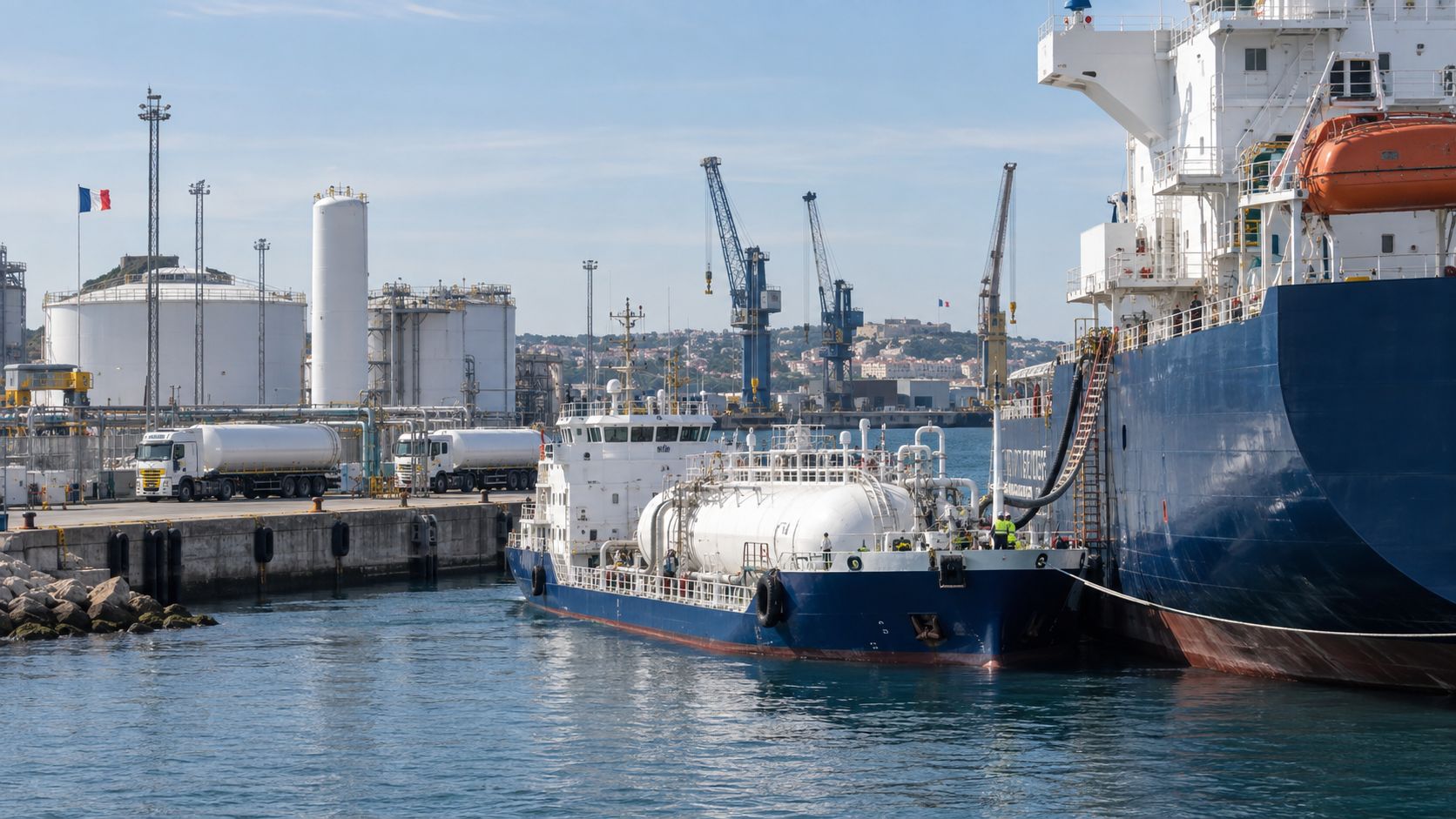
Transport, ship bunkering and industrial clients — key segments and players
France is one of the key small-scale LNG markets in Europe. The country combines developed gas infrastructure, major ports, a strong biomethane sector and an active policy of decarbonising transport and shipping. Small-scale LNG is used in three main directions: road transport (NGV/LNG trucks), ship bunkering and supply to industrial / off-grid customers.
1. Market overview
Small-scale LNG in France relies on large terminals (Dunkirk, Fos-sur-Mer, Montoir-de-Bretagne) that offer truck-loading and small-scale vessel services, as well as on growing biomethane production, part of which is liquefied (Bio-LNG). Elengy (terminal operator) offers a “liquefaction by equivalence” service — converting biomethane sustainability certificates into Bio-LNG for loading into tankers and micro-LNG carriers.
France is Europe’s biomethane leader: hundreds of grid-injection plants, a strong project pipeline and support mechanisms (feed-in tariffs, CPB certificates, the IRICC scheme for transport).
2. Road transport sector
France has a developed natural gas vehicle (NGV) market. By the end of 2025 there were around 39,000 gas vehicles and more than 750 CNG filling stations. A significant share of consumption is already bio-CNG / biomethane.
LNG trucks (heavy-duty tractors) are used on long-haul routes. Manufacturers (Iveco, Volvo Trucks, Scania) actively offer LNG / Bio-LNG models. Iveco’s sales of gas trucks and vans in France remain among the highest in Europe.
Drivers: environmental requirements, corporate emission targets, availability of Bio-LNG and tax/certificate mechanisms (including the forthcoming IRICC scheme).
3. Ship bunkering
France is an important LNG bunkering hub in Europe. Main ports: Marseille-Fos, Dunkirk, Le Havre, Montoir. Specialised bunker vessels (Gas Agility, Gas Vitality and others) serve large container ships and cruise vessels.
CMA CGM is one of the largest offtakers. The company is actively converting its fleet to dual-fuel LNG and plans to use biomethane and e-methane. Bio-LNG bunkering operations are already taking place in French ports (e.g. Molgas in Le Havre).
FuelEU Maritime since 2025 is strengthening demand for low-carbon fuels. The French LNG bunkering market is estimated in the region of $90–100+ million in the mid-decade, with moderate but steady growth.
4. Industrial and off-grid customers
Small-scale LNG is used to supply industrial sites and locations without pipeline access (or as peak / backup fuel). Deliveries are made by road tanker from Elengy terminals and through regional distributors.
Growing industrial interest in Bio-LNG is linked to decarbonisation targets and the ability to use sustainability certificates (ISCC / PoS).
5. Main market participants
| Player | Role |
|---|---|
| Elengy (Engie) | Terminal operator (Fos, Montoir); truck and small-scale loading; Bio-LNG by equivalence |
| TotalEnergies | LNG supply, bunkering, partnerships (incl. with CMA CGM) |
| CMA CGM | Major LNG bunkering offtaker; dual-fuel fleet |
| Molgas and other traders | Distribution, Bio-LNG bunkering (Le Havre and others) |
| Biomethane producers | Feedstock for Bio-LNG; hundreds of grid-injection plants |
| Iveco, Volvo, Scania | Suppliers of LNG/Bio-LNG trucks |
6. Outlook
- Rising share of Bio-LNG in transport and bunkering under FuelEU Maritime and national mechanisms.
- Further development of small-scale services at terminals (tankers + micro-carriers).
- Opportunities for regional suppliers and logistics schemes, including certified biomethane deliveries.
7. Conclusion
Small-scale LNG in France is a mature, multi-segment market. Strong positions in bunkering (Marseille, Dunkirk, Le Havre), a growing NGV/LNG truck fleet and access to one of Europe’s largest biomethane sectors create solid demand. The key trend for the coming years is the shift from conventional LNG to Bio-LNG and the rising importance of certification. For players from other European regions France remains an attractive offtake market and a logistics hub.