
by Eurolng.com Staff
Bio-LNG growth in Belgium: Zeebrugge as a North-West European hub
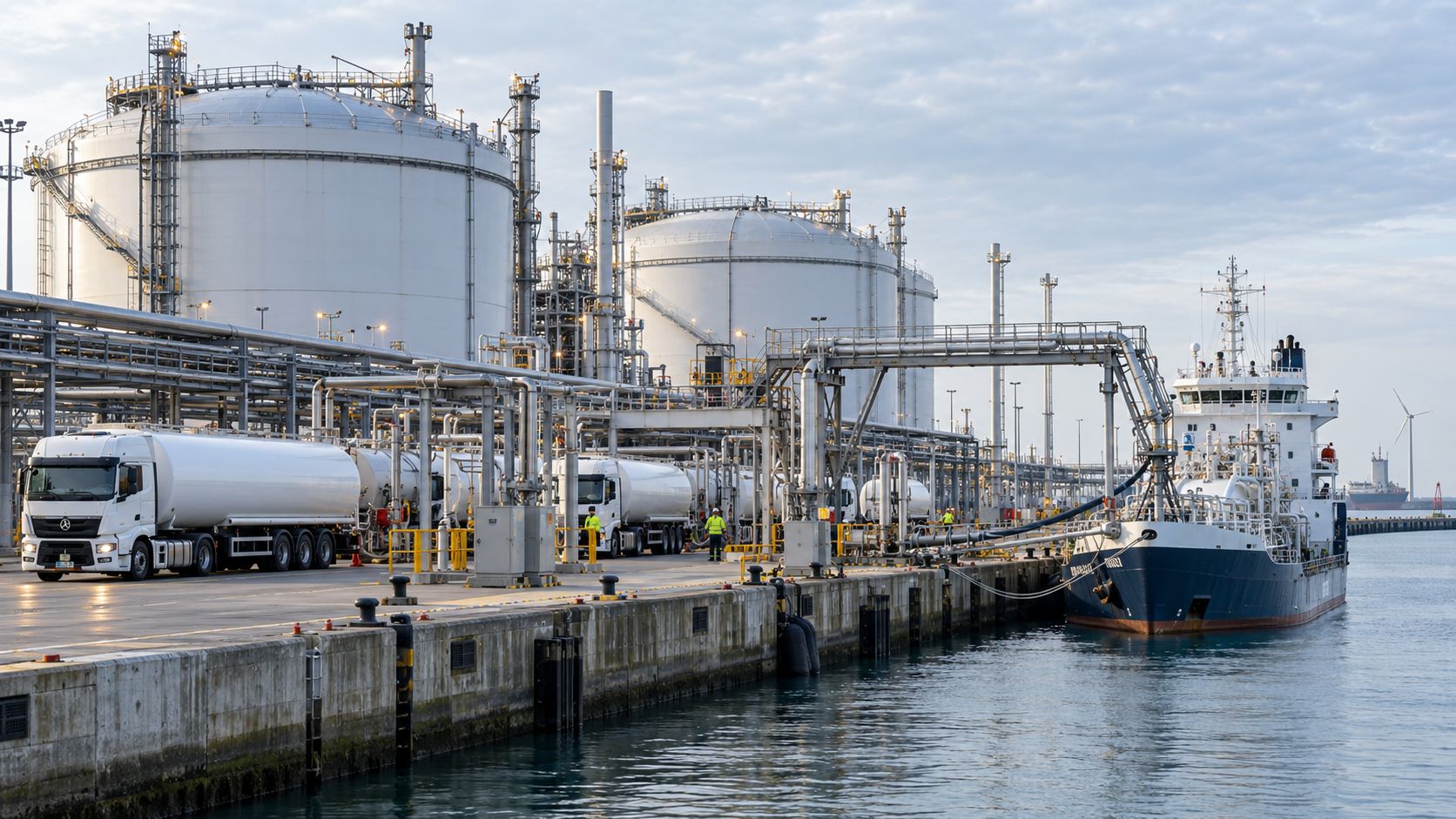
Volumes, infrastructure and demand drivers 2023–2025
Belgium has become one of the fastest-growing Bio-LNG markets in Europe. The centre of this growth is the Zeebrugge terminal (Fluxys LNG). The country acts more as a logistics and production hub than as a large domestic consumer: a significant share of volumes leaves by road tanker to neighbouring countries and goes into ship bunkering.
1. Volume trends
| Year | Bio-LNG at Zeebrugge | Comment |
|---|---|---|
| 2023 | Low base | Start of visible growth |
| 2024 | ×9 vs 2023 | Sharp jump |
| 2025 | > 2.5 TWh (+73%) | Strong growth continues |
Demand structure in 2025:
- ~60% of truck loadings — Bio-LNG (mainly for truck filling stations);
- ~40% of small ship loadings — Bio-LNG (bunkering).
2. Infrastructure and truck loading
- Four new automated truck-loading bays have been in operation since January 2025.
- Number of loadings in 2025: 8,440 (up more than 10%).
- Capacity increased to about 20,000 loadings per year.
- Fluxys is developing biomethane liquefaction and, from 2026, RFNBO methane liquefaction.
3. Who consumes it and where it goes
Main outlets:
- Heavy-duty road transport — the primary driver (filling stations in Belgium and neighbouring countries);
- Marine bunkering (truck-to-ship and small-scale);
- Export by road tanker to Germany, France and the Netherlands.
Key players:
- Fluxys LNG — terminal operator, truck loading, biomethane liquefaction;
- Molgas — logistics and truck-to-ship Bio-LNG bunkering;
- Terminal shippers and distributors selling molecules via truck loading.
4. Why Bio-LNG is growing
- Regulation — FuelEU Maritime, EU ETS, RED III.
- Drop-in fuel — usable in existing LNG trucks and ships.
- Ready infrastructure at Zeebrugge — liquefaction + truck loading.
- Demand from Germany and other neighbouring markets.
5. Constraints and outlook
Strengths: very fast volume growth, high bio share, capacity expansion.
Constraints: relatively small domestic consumption market, dependence on neighbouring demand and biomethane prices, competition from electrification.
Outlook: growth is expected to continue in road transport and bunkering. Zeebrugge is consolidating its position as one of the key Bio-LNG hubs in North-West Europe. Fluxys is already expanding services, including RFNBO methane.
6. Conclusion
Belgium shows one of the highest Bio-LNG growth rates in the region. The driver is the Zeebrugge terminal and demand from heavy transport and shipping. Volumes rose almost tenfold in two years, and the bio share in truck loading reached about 70%. The country functions as a hub rather than a large end-user market, and this role is likely to strengthen in the coming years.