
by Eurolng.com Staff
Qatar and the Strait of Hormuz crisis: LNG impact, recovery and the path to 100+ mtpa
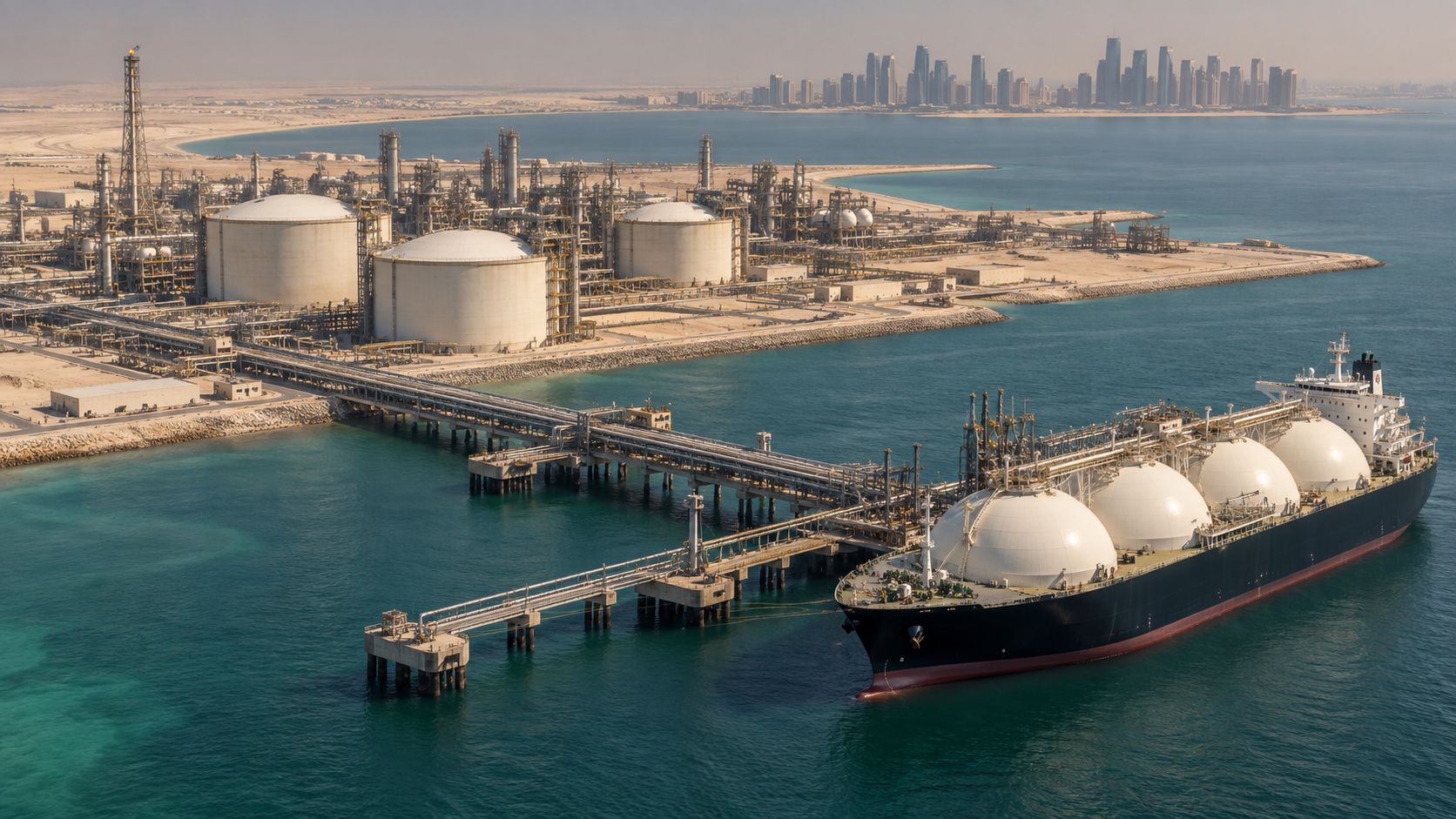
Ras Laffan attacks, pre-crisis EU deliveries, repair timelines and North Field expansion
The crisis around the Strait of Hormuz and the strikes on the Ras Laffan industrial complex in March 2026 became the biggest shock to Qatari LNG in recent years. Qatar — one of the world’s two leading LNG exporters — temporarily lost a significant share of capacity, while logistics through Hormuz were nearly paralysed. Below: what happened, what volumes went to the EU before the crisis, how quickly production can recover, and when output can exceed 100 million tonnes per year.
1. Pre-crisis Qatar LNG deliveries to the EU
Before March 2026, Qatar was a stable, though not the largest, LNG supplier to Europe. Industry estimates indicate:
- In 2025, Qatari LNG deliveries to Europe (EU-27 + UK) totalled about 11.9 bcm (~7–8 % of European LNG imports).
- In tonnage terms this is roughly 8–9 mt (estimates vary within this range).
- Most volumes went to Italy, Poland and Belgium (about 10.8 bcm of the 11.9 bcm); the rest to Spain and the UK.
| Country / region | Qatari share of LNG imports (2025) | Comment |
|---|---|---|
| Italy | ~33 % of LNG imports | Highest exposure in the EU |
| Poland | ~25 % of LNG imports | Important term-contract buyer |
| Belgium | ~16 % of LNG imports | Hub and long-term volumes |
| EU overall | ~6–8 % of LNG imports | US remains the dominant supplier |
Thus, before the crisis Qatar was not a “critical” supplier for the EU as a whole (unlike the US), but it mattered a lot for individual countries — especially Italy and Poland. The sharp cut in deliveries after March 2026 increased pressure on US and spot LNG.
2. How the crisis affected Qatar
In mid-March 2026, missile strikes damaged two of the 14 liquefaction trains at Ras Laffan — Train 4 and Train 6. Combined capacity: about 12.8 mtpa, or roughly 17 % of Qatar’s export capacity.
QatarEnergy has estimated revenue losses from the damage at around $20 billion a year, with full repairs expected to take 3 to 5 years.
At the same time, the near-total blockage of the Strait of Hormuz sharply reduced the ability to export LNG. By September 2026 Qatar was producing only “very minute” volumes, and global markets reacted with spot price spikes in Asia and Europe to levels not seen since 2022.
3. How quickly can Qatar restore production?
Two different processes must be separated.
| What is restored | Timeline |
|---|---|
| Undamaged trains (≈83 %) | After Hormuz reopens — return to normal within a couple of weeks; earlier guidance: ~50 % in one month, ~80 % in two months |
| Train 4 and 6 (12.8 mtpa) | Repairs: 3–5 years |
| GTL (Pearl / Shell) | Return expected around Q1 2027 |
Energy Minister and QatarEnergy CEO Saad al-Kaabi (September 2026) confirmed that once Hormuz reopens, Qatar can resume normal operations “within a couple of weeks” — excluding the 17 % of capacity that will remain offline for years.
4. Crisis exit scenarios
The key trigger is safe, sustained navigation through Hormuz.
- Fast scenario: the strait reopens → undamaged capacity is back online within weeks.
- Prolonged scenario: lasting instability → delays to both exports and construction of new North Field trains.
5. North Field expansion and the path to 100+ mtpa
Before the crisis Qatar planned the world’s largest LNG capacity build-out:
| Project | Capacity | Status / timing |
|---|---|---|
| North Field East (NFE) | ~32 mtpa | First train — H1 2027 (shifted from 2026) |
| North Field South (NFS) | ~16 mtpa | Target around 2028 |
| North Field West | ~16 mtpa | Horizon around 2030 |
Pre-crisis nameplate capacity was about 77 mtpa. After NFE — roughly 110 mtpa; with NFS — around 126 mtpa.
Exceeding 100 mtpa is realistic in the 2027–2028 window if Hormuz normalises and NFE trains come online as planned.
6. Implications for the market and the EU
- For the EU, the loss of Qatari volumes (previously ~8–9 mt / ~12 bcm per year) increased reliance on the US and the spot market.
- Italy and Poland were most exposed due to Qatar’s high share in their LNG imports.
- Longer term, the new capacity wave (including Qatar’s) can still ease the market by the end of the decade — after Hormuz normalises and repairs are completed.
7. Conclusion
Before the crisis, Qatar supplied Europe with about 11.9 bcm of LNG per year (~8–9 mt), mainly to Italy, Poland and Belgium. The Ras Laffan strikes removed 17 % of capacity for 3–5 years, and the Hormuz blockage nearly halted exports. Undamaged capacity can return within weeks of the strait reopening. Crossing 100 mtpa is tied to North Field East and is realistic in 2027–2028 if logistics normalise.