
by Eurolng.com Staff
Bio-LNG logistics analysis
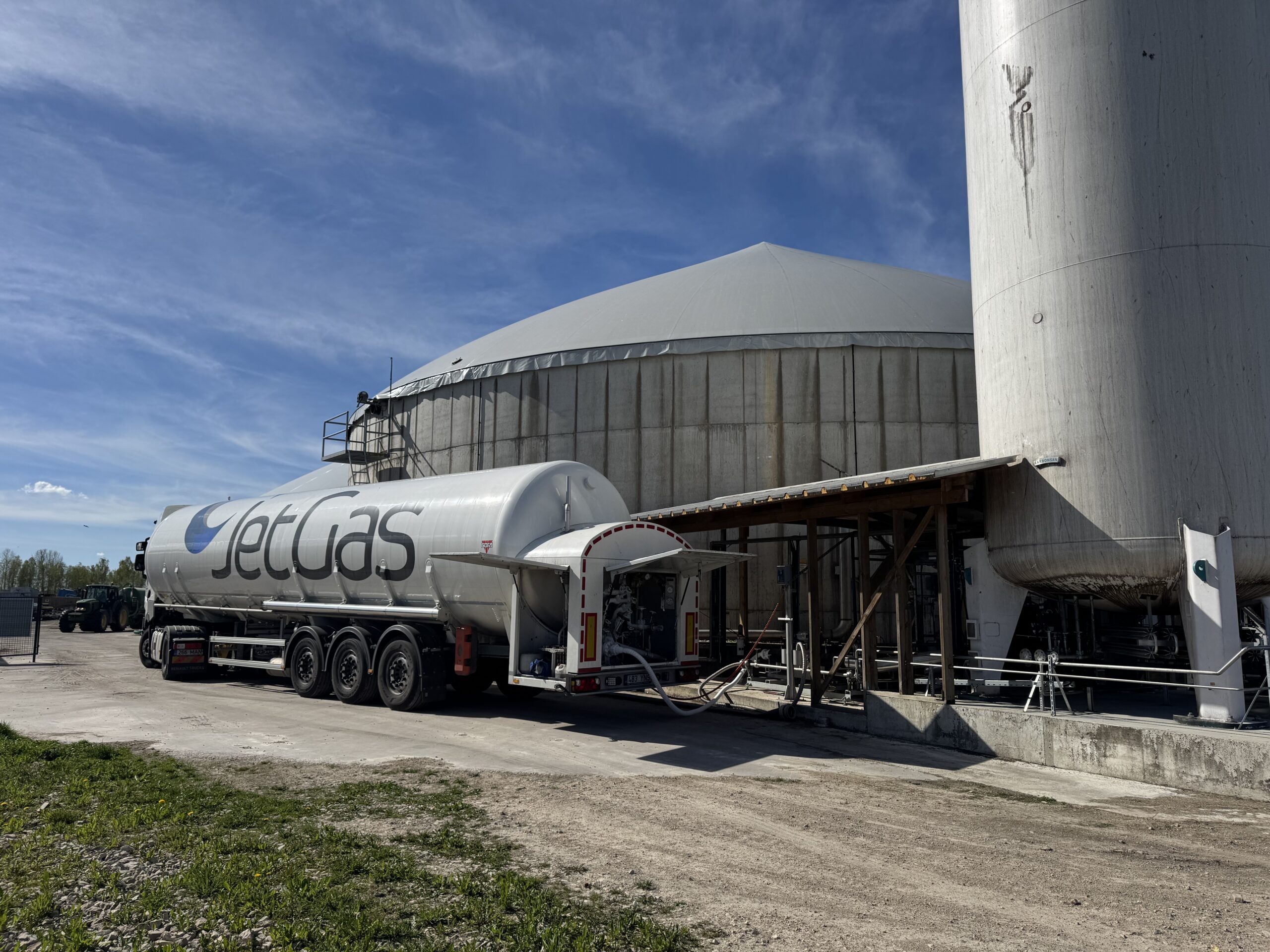
Supply chain, transport and key challenges for the Baltic–German market
1. Structure of the supply chain
Bio-LNG logistics differs from conventional LNG in that the product is often produced in a decentralised way (biogas plants → upgrading → liquefaction) and delivered to end users by road tanker rather than by large-scale LNG carriers.
Typical chain:
- Feedstock (manure, waste, residual biomass) → biogas plant
- Upgrading to biomethane → grid injection or direct liquefaction
- Liquefaction (local or centralised) → Bio-LNG
- Storage and loading into cryogenic semi-trailers
- Road delivery to filling stations / industrial customers / bunkering
- Transfer of PoS (Proof of Sustainability) via systems such as NABISY / ISCC
2. Transport: cryogenic semi-trailers
The main mode of delivery for small-scale Bio-LNG is the cryogenic semi-trailer (LNG trailer). Typical parameters:
| Parameter | Typical value |
|---|---|
| Tank volume | 45–56 m³ (liquid) |
| Energy per trip | 230–280 MWh (depends on density and HHV/LHV) |
| Product temperature | approx. –160…–150 °C |
| Boil-off losses | 0.1–0.3 % per day with good insulation |
| Loading / unloading time | 1–3 hours (depends on infrastructure) |
| Effective delivery radius | usually up to 500–800 km one way |
Quantity is typically determined by weight on the receiver’s scales or by flow meter / CMR. Contracts often state that quantity is determined by CMR at the loading point or by the buyer’s weighbridge.
3. Key routes (Baltic → Germany / Netherlands)
For suppliers from Estonia, Latvia and Lithuania the most relevant directions are:
- Estonia / Latvia → Northern and Central Germany (filling stations, logistics hubs)
- Baltic → Netherlands (Gate terminal / filling stations) — with possible return load of conventional LNG
- Within Germany: from liquefaction plants to the network of ~180–200 public LNG stations
4. Main challenge: empty positioning (backhaul)
The single largest cost driver in Bio-LNG logistics is empty running (empty backhaul). A cryogenic trailer travelling from the Baltics to Germany or the Netherlands often returns empty. This can account for 30–50 % or more of the total trip cost.
Solutions that reduce cost:
- Backhaul model: deliver Bio-LNG one way + load conventional LNG (e.g. at Gate) on the return leg
- Circular routes linking several liquefaction and consumption points
- Long-term contracts with fixed loading/unloading slots
5. Main cost drivers of logistics
| Factor | Impact |
|---|---|
| Distance and empty running | Largest contribution to €/MWh |
| Payload per trailer (MWh) | Higher density/energy → lower unit cost |
| Loading/unloading waiting time | Directly affects fleet utilisation |
| Boil-off and losses | Especially critical during long idle periods |
| Certification and PoS transfer | Administrative cost and delay risk |
| Return cargo (backhaul) | Can radically improve trip economics |
6. Certification and documentation
Traceability of sustainability is critical for Bio-LNG. Key elements:
- PoS (Proof of Sustainability) — usually transferred via NABISY (Germany) or similar systems
- ISCC EU / RED II–III certification
- Specification of feedstock (manure, waste, etc.) and GHG value (g CO₂eq/MJ)
- CMR + quantity data (weight / energy)
7. Conclusions and opportunities
Bio-LNG logistics in the Baltic–German corridor has the following characteristics:
- Road delivery by cryogenic semi-trailer dominates (230–280 MWh per trip).
- The main cost-reduction lever is eliminating empty running through backhaul (Bio-LNG one way + LNG the other way).
- Germany, with ~180–200 LNG filling stations and almost 100 % Bio-LNG share at those stations, remains the key offtake market.
- Successful logistics requires coordination of loading slots, PoS transfer, minimisation of idle time and control of boil-off.
- For Baltic suppliers, the model “Bio-LNG to Germany/Netherlands + return load of conventional LNG” is the most promising from an economic perspective.