
by Eurolng.com Staff
Bio-LNG market development in Spain
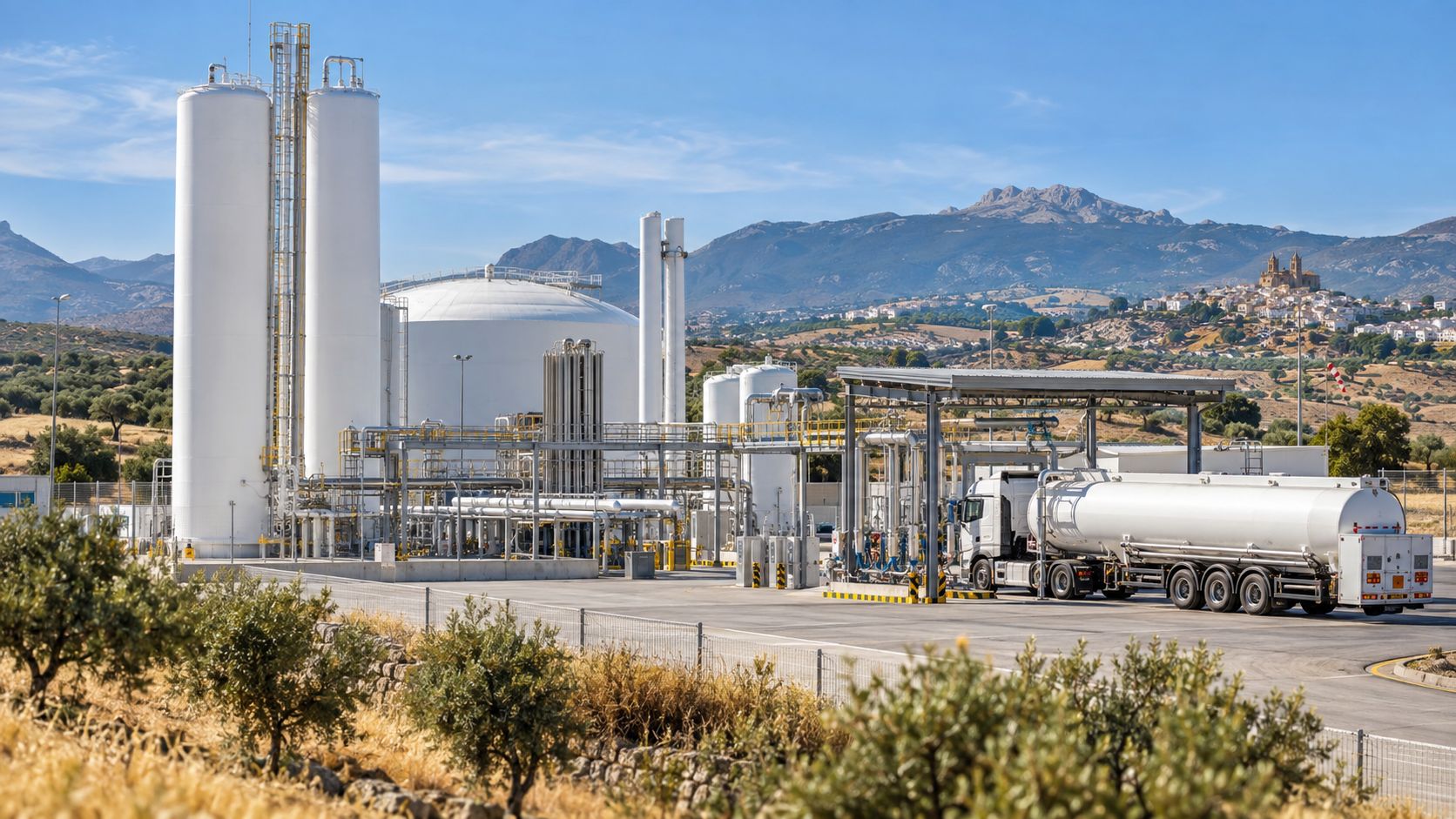
From a near-zero base to one of Europe’s fastest-growing markets
Spain lagged behind the European biomethane leaders (Germany, France, Italy, Denmark) for a long time. In 2021 the country had essentially one operating plant. By 2025–2026 the picture has changed sharply: the number of plants has multiplied, planned investments are the largest in Europe, and the regulatory framework has begun to actively stimulate demand.
1. Current market situation
As of early to mid-2026:
- Operating biomethane plants: about 22–24 (most already injecting into the grid). The number has almost doubled in a year.
- Biomethane injected into the grid: growth from ~305 GWh in 2024 to ~394 GWh in 2025.
- Several plants already produce Bio-LNG (bioGNL) for transport and potentially for bunkering.
- Sedigas forecast: up to 46 plants by the end of 2026 with capacity of around 4.6 TWh/year.
2. Investment — European leader
According to the EBA, Spain ranks first in Europe for planned biomethane investment — about €4.8 billion through 2030 (more than France and Italy combined).
Major players include Enagás Renovable, Naturgy / Nedgia, Repsol, Moeve (ex-Cepsa), Verdalia Bioenergy, Genia Bioenergy, as well as foreign investors. Nedgia already has dozens of projects in the connection pipeline; total connection applications run into the hundreds and could potentially deliver tens of TWh.
3. Regulatory driver
- PNIEC (national energy and climate plan): target of 20 TWh of biogas/biomethane by 2030.
- Guarantees of origin (GoO) system is already operational.
- Grid connection procedures have been simplified (CNMC).
- In 2026 work is advancing on a mandatory biomethane quota for the non-transport sector (draft: from 0.5 % in 2028 to 6 % by 2035). This will create guaranteed demand.
4. Bio-LNG in Spain
The Bio-LNG segment is still at an early stage: only a few plants produce liquefied biomethane. Most volume still goes into the grid. Interest in Bio-LNG is rising, however, driven by:
- heavy-duty transport and the need to meet renewable targets in transport;
- port infrastructure and bunkering potential;
- the possibility of export / virtual pipeline and mass-balance schemes.
Market forecasts for Bio-LNG in Spain show a high CAGR (over 30 % to 2030 in some estimates), although absolute volumes remain modest compared with Germany or Scandinavia.
5. Outlook to 2030
- If the current project pipeline is realised, capacity could rise to 10–14+ TWh within a few years.
- Spain has one of the highest biomethane potentials in Europe (agricultural residues, livestock).
- The introduction of quotas and further simplification of connections should accelerate the shift from paper projects to real commissioning.
6. Conclusion
Spain is one of the fastest-growing biomethane markets in Europe. From a near-zero base the country has, within a few years, reached dozens of operating plants and hundreds of planned ones, attracted record investment and started to shape demand through quotas. Bio-LNG still accounts for a small share, but with the development of transport and port infrastructure it has solid prospects. For suppliers and traders from other European regions the Spanish market is becoming increasingly attractive both in terms of volumes and long-term offtake contracts.